Should You Put a Rug Over Rental Carpet? When It Helps—and When It Doesn’t
Can you put a rug over carpet? Yes—but whether it works depends on the carpet, rug size, stability, and what you’re actually trying to change.
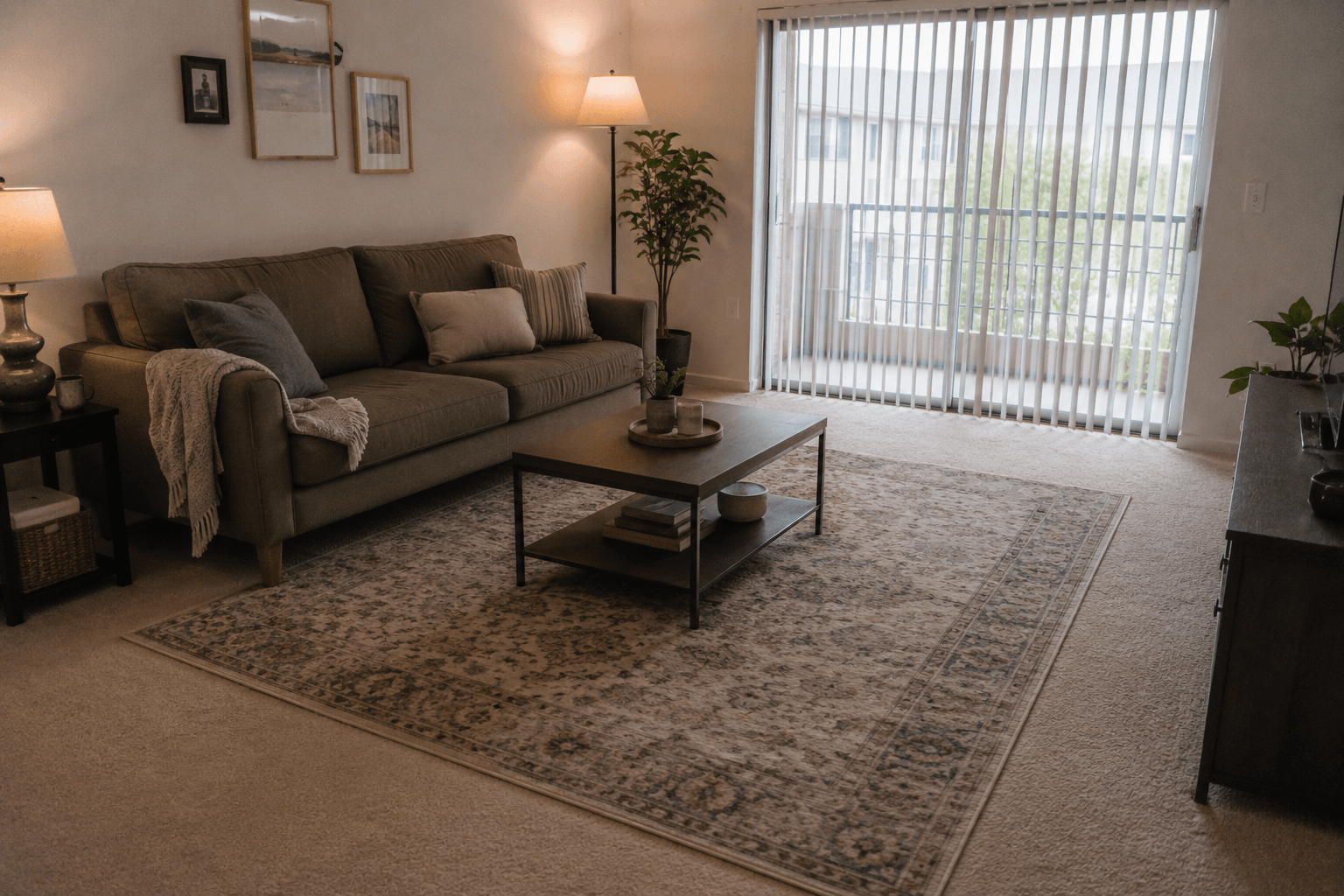
Wall-to-wall carpet can make an otherwise workable rental feel harder to style.
You usually cannot replace it, so an area rug seems like an obvious fix. It can add color, give the furniture a clearer center, and reduce how much of the beige or gray carpet your eye notices first.
But a rug does not replace the floor. It adds another layer on top of it.
So the useful question is not simply “Can I put a rug over carpet?” You can. The better question is whether the rug will change what bothers you enough to justify the extra cost, thickness, and potential movement.
Before you shop, figure out what problem you are actually trying to solve—and what kind of surface the rug will have to sit on.
Quick Take
Can You Put a Rug Over Carpet? Usually, Yes
An area rug can sit over wall-to-wall carpet and work perfectly well.
The complication is that the rug is not sitting on a rigid floor. The carpet and padding underneath compress as you walk across them, so the top rug can shift, ripple, or feel less stable than the same rug would on wood or tile.
That does not make rug-over-carpet a bad idea.
It just means the base matters as much as the rug.
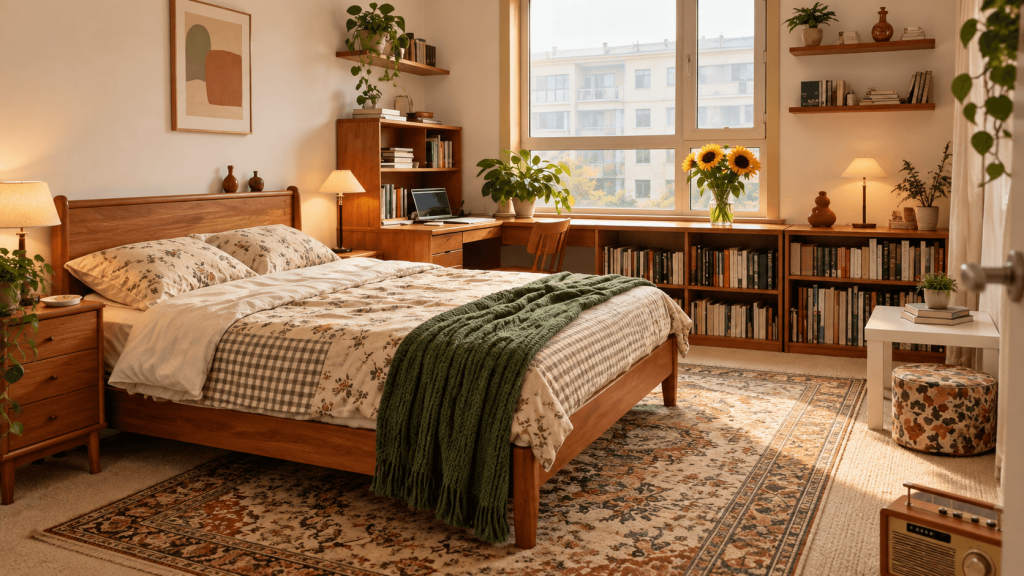
First, Ask What You Actually Dislike About the Carpet
Before looking at patterns, colors, or rug sizes, look at the carpet itself.
What are you trying to change?
If the problem is mostly visual, a rug can have a large effect.
Maybe the carpet is rental beige and makes the whole room feel washed out. Maybe your sofa, coffee table, and chairs seem to float separately because the same carpet runs underneath everything. Or maybe you simply want one part of the room to feel chosen instead of landlord-provided.
Those are problems a rug can actually address.
A rug can introduce contrast, create a visual boundary around the furniture, and give your eye a stronger surface to focus on.
But some carpet problems are not visual.
If you dislike the soft feeling underfoot, the thickness, an uneven surface, or carpet as a flooring type in general, putting another textile on top will not change the underlying floor very much.
And if you are dealing with persistent odor, moisture, visible damage, or another condition issue, that needs to be treated as a carpet problem—not hidden under a rug.
A rug can change what the floor looks like.
It cannot make the carpet underneath stop being carpet.
If you are still deciding which part of an ugly rental floor is actually worth dealing with, start with Working With Rental Flooring You Can’t Replace before choosing a workaround.
You Probably Don’t Need to Cover as Much Carpet as You Think
Once you decide the problem is mostly visual, it’s tempting to think in terms of coverage.
How much of the beige carpet can I hide?
That can quickly turn into shopping for the largest rug that fits the room—or the budget.
But maximum coverage isn’t necessarily what makes the biggest difference.
Think about a carpeted living room with a sofa, coffee table and chair. Even though the carpet covers the entire room, your eye doesn’t give every square foot equal attention. The open floor around the furniture tends to carry much more visual weight than the narrow strips along the walls or behind the sofa.
Put a rug under that main furniture grouping, and something changes.
The rug becomes the surface your eye associates with the seating area. The landlord carpet is still visible around it, but it starts to behave more like a background.
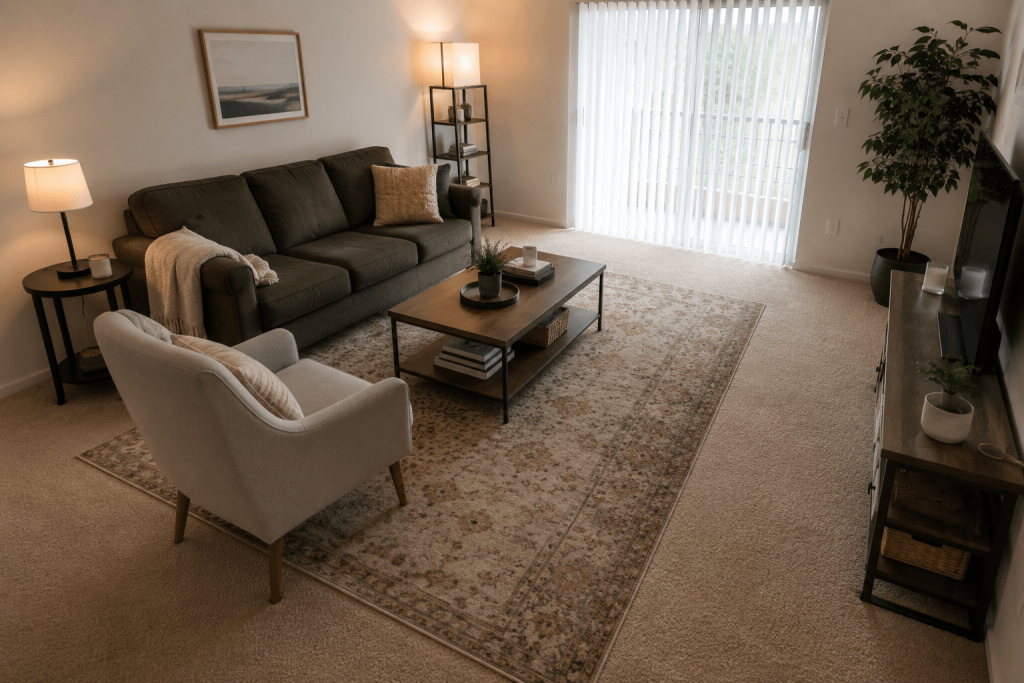
The goal is not to make the carpet disappear.
It is to change which surface your eye notices first.
This is also why buying a small rug just to hide the ugliest patch of carpet can backfire.
If the rug floats in the middle of the room without relating to the furniture, it can make the floor look more accidental—not less. It may even draw attention to the exact area you were trying to hide.
Instead, look at the furniture arrangement.
Where does the seating area begin and end? Which sections of floor are actually exposed between the pieces you use every day? Could one rug make those pieces read as a single zone?
That does not mean following one universal rug-size formula.
It means the rug should look as though it belongs to the room, not as though it was dropped on top of a problem.
If the main zone looks better but everything around it still disappears into beige, the next issue may not be rug coverage. It may be the way the furniture and textiles are blending into the floor.
Before You Shop, Define the Setup
Once you know a rug could help, resist opening Amazon and choosing by pattern first.
There are three things worth checking in the actual room before you buy anything.
Mark the rug footprint on the floor
Estimate the size you are considering and mark its corners.
You do not need a complicated measuring setup. Small pieces of painter’s tape beside the proposed corners—or any temporary markers that do not attach to the carpet itself—are enough to help you see the footprint.
Then stand back.
Does that rectangle actually connect the sofa, coffee table, chairs, or bed into one zone?
Does it stop in an awkward place?
Does the main walking path cut directly across an edge?
This is more useful than judging rug size from a product photo because it tells you how that size behaves in your furniture arrangement.
If you are deciding between two sizes, mark both before ordering.
The larger rug is worth paying for only if the extra area actually improves the room.
Press your hand into the carpet
Now check what the rug will be sitting on.
Go to the area where you plan to place it and press your hand firmly into the carpet.
Does the surface feel relatively short and firm?
Or does your hand sink noticeably into a thick, cushioned layer?
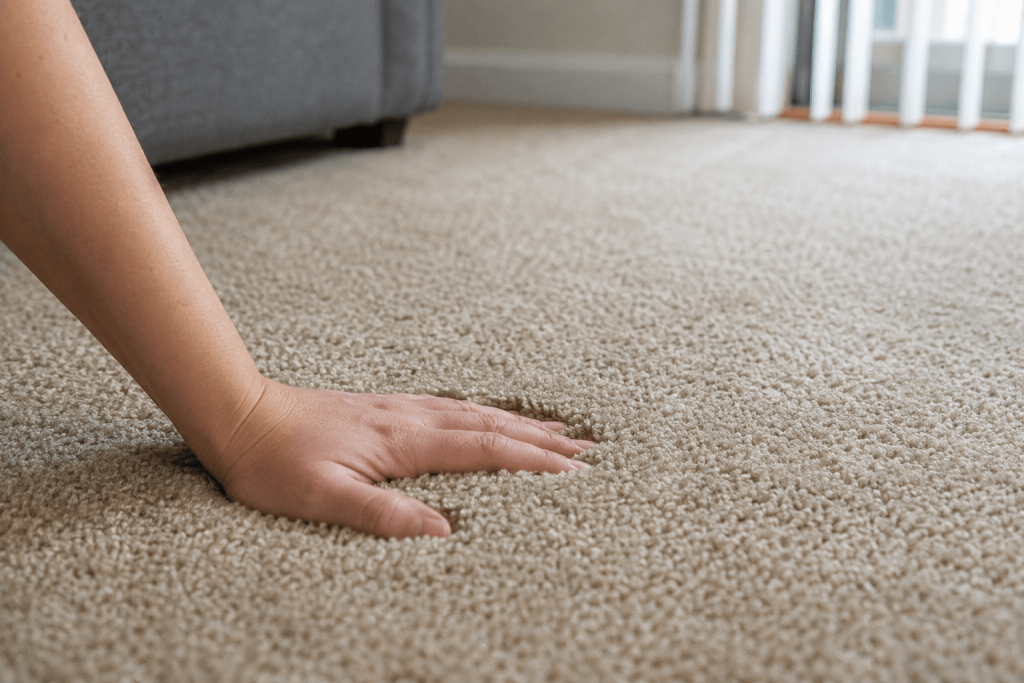
A firmer carpet is generally an easier base for another rug because there is less movement underneath it.
A plush carpet compresses more as people walk across the room. That gives the rug above it more opportunity to creep, ripple, or feel unstable.
You do not need to identify the carpet construction or calculate pile height.
You are simply trying to answer:
Am I putting a rug on a fairly stable base, or am I stacking one soft layer on top of another?
The softer the base feels, the more cautious I would be about choosing another deep, cushioned rug purely because it looks cozy online.
A lower-profile top layer may be easier to manage—but the real test is whether the combination lies flat and feels stable in your room.
Check the extra height where it matters
A rug over carpet also adds height.
If you plan to use a rug pad, you are adding another layer again.
Most of the room may not care. Certain spots do.
Look at nearby closet doors, interior doors, low furniture edges, floor vents, and transitions into another room.
Then pay attention to your most-used walking paths.
A slightly raised edge behind the sofa is one thing. A raised edge exactly where you walk between the living room and kitchen several times a day is another.
This check takes a minute and can save you from buying a setup that looks good but feels irritating every time you cross the room.
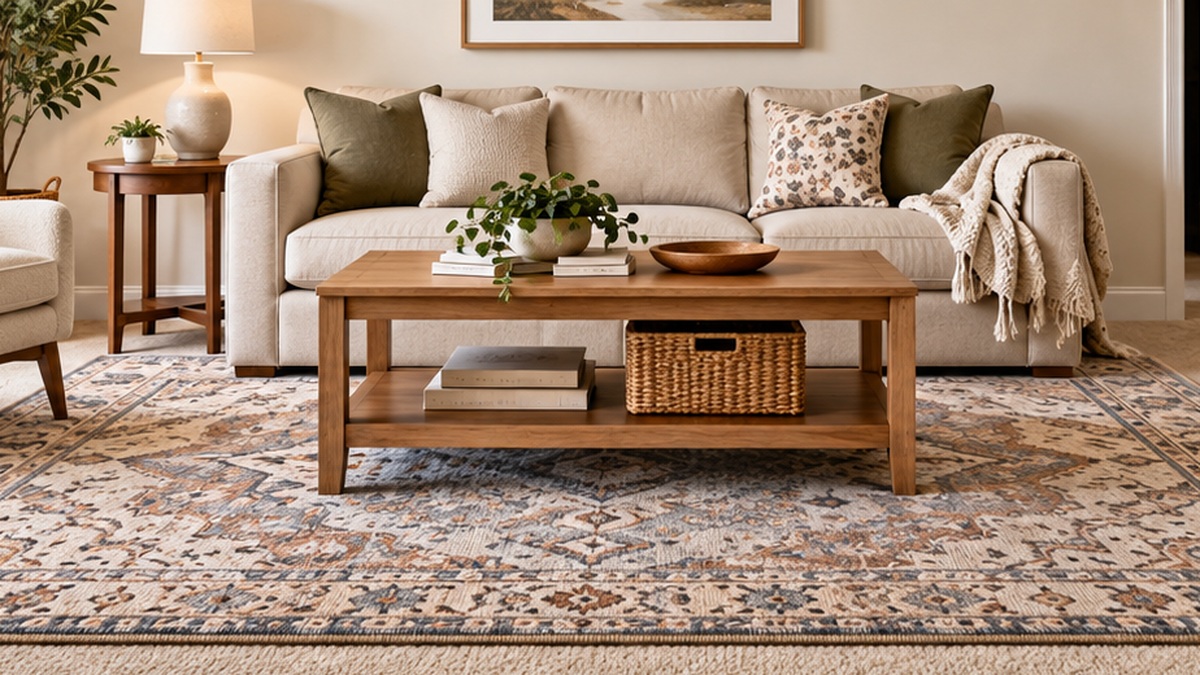
IF THE MAIN PROBLEM IS VISUAL
A Low-Profile Rug Example: Loloi Layla
Once you know the footprint you need, a lower-profile rug is a useful place to start because it adds less extra depth over the carpet underneath.
Why this one fits the filter: The Layla collection has a 0.13-inch pile and comes in several sizes, so you can choose around the furniture zone instead of buying the biggest rug simply to hide more carpet.
Check first: Mark the footprint in your room and check how firm the existing carpet feels. A low-profile rug can still move if the base underneath is soft.
Paid link — we may earn a commission from qualifying purchases.
Check sizes and colors on Amazon →The Rug Has to Stay Where You Put It
A rug can move on carpet even though neither surface feels slippery.
That movement happens differently from a rug sliding across hardwood.
The carpet underneath compresses as people walk across it. Over time, that repeated movement can make the area rug creep, develop ripples, bunch around furniture, or lift at an edge.
Furniture helps, but it does not automatically solve the problem.
A sofa sitting on one part of the rug may anchor that section while the exposed side still moves.
If the rug stays flat during normal use, there is no reason to solve a problem you do not have.
But if it starts shifting, do not automatically reach for the same nonslip pad you would use on a hard floor.
Look for a pad made for rug-on-carpet use
“Rug pad” is a broad category.
Some pads are designed to stop rugs from sliding on smooth hard floors. A rug lying over wall-to-wall carpet has a different movement problem.
If you need extra stability, look for a product whose manufacturer specifically says it is intended for rug-on-carpet or carpet-to-carpet use.
That distinction is real: manufacturers sell separate pad designs specifically for area rugs over carpeting because the goal is to reduce shifting, wrinkling, and bunching on a compressible base.
Do not choose only by material name or by how “non-slip” the packaging sounds.
Check the surfaces the product is actually designed to sit between.
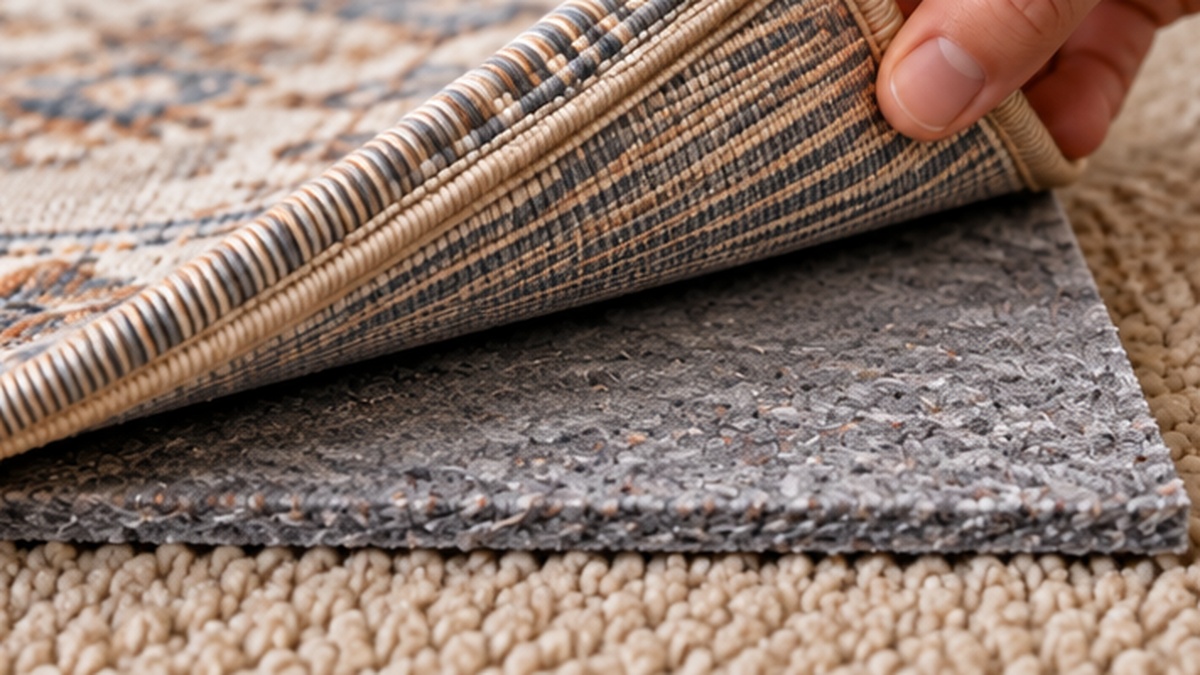
IF THE RUG KEEPS CREEPING OR BUNCHING
Mohawk Home Dual Surface Rug Pad
This is a more relevant type of pad for rug-over-carpet use than a generic hard-floor nonslip mesh because the manufacturer gives specific instructions for using it over carpeting.
For carpet: Mohawk instructs you to place the felt side against the carpet and the latex side toward the area rug.
Check first: The 1/4-inch pad adds height, so recheck doors, transitions, and raised edges before using it in a tight walking path.
Paid link — we may earn a commission from qualifying purchases.
Check current sizes on Amazon →Be more cautious with tape on landlord-owned carpet
Double-sided rug tape is tempting because it looks like a simple solution.
But “removable” does not automatically tell you what months of contact will do to a particular landlord-owned carpet.
If you are considering any adhesive product, check the manufacturer’s approved surfaces and removal instructions before attaching it to flooring you do not own.
For a rental, I would rather use a solution explicitly designed for carpet-to-carpet stability than make adhesive the default.
Test the setup the way you actually live
Once the rug is down, do more than stand back and look at it.
Walk across it from several directions.
Pull out the chair that sits partly on it.
Move around the coffee table.
Vacuum an edge.
If there is a nearby door, open it fully.
Then leave the rug in place and pay attention to whether it starts creeping or developing a raised edge.
The goal is not to make an area rug permanently immovable.
It is to find out whether the extra layer has created something you will have to keep fixing.
A rug that improves the room but needs to be straightened every few days is not a very successful workaround.
So, Is a Rug Over Rental Carpet Worth It?
By this point, the decision usually has less to do with whether rugs and carpet are “supposed” to go together.
It comes down to what the rug changes—and what it asks you to tolerate in return.
| WHAT YOU’RE WORKING WITH | WHICH WAY IT POINTS |
|---|---|
| Carpet is in reasonable condition but visually bland | TOWARD ADDING A RUG |
| One exposed zone is what bothers you most | TOWARD ADDING A RUG |
| The rug can anchor the furniture arrangement | TOWARD ADDING A RUG |
| Existing carpet feels relatively firm | EASIER SETUP |
| Carpet is very plush or uneven | THINK TWICE |
| The rug keeps creeping, rippling or bunching | FIX THE STABILITY FIRST |
| There’s persistent odor, moisture, visible damage, or another condition problem | DEAL WITH THE CARPET FIRST |
| You wouldn’t want the rug in another home | THINK HARDER ABOUT THE SPEND |
That last question is particularly useful in a rental:
Would you still want this rug after you move?
If the answer is yes, the purchase becomes easier to justify.
You are buying something that improves this room now but is not permanently tied to this room.
If the answer is no—because you need an unusually large or expensive rug solely to tolerate one landlord’s wall-to-wall carpet—the calculation changes.
That does not automatically make it a bad purchase. You may decide that enjoying the room for the next year or two is worth paying for.
But that is different from treating an area rug as an automatic fix.
The useful question becomes:
Am I buying a rug I actually want, or am I paying mainly to hide a floor I cannot change?
Bottom Line
A rug over rental carpet works best when the underlying carpet is basically fine and the problem is mainly visual.
Use the rug to define the part of the room that matters most rather than trying to cover every visible inch. Before ordering, mark the footprint, check how soft the carpet underneath feels, and think about whether the extra layer will stay flat in the places you actually walk.
If movement becomes the weak point, look for a pad specifically intended for rug-on-carpet use rather than treating every rug pad as interchangeable.
And before spending more just to maximize coverage, ask whether you would still want the rug in your next home.
If one large rug still leaves the exposed rental flooring as the main thing bothering you, compare Temporary Flooring vs a Large Rug: Which Is Worth It in a Rental? before buying an even bigger rug.
FAQs
Can you put an area rug over wall-to-wall carpet?
Yes.
It works best when the carpet underneath is in reasonable condition and the area rug lies flat and stable during normal use.
The combination becomes harder to manage when the carpet is very plush, uneven, or the top rug constantly creeps or ripples.
What type of rug works best over carpet?
There is no single rug construction that works over every carpet.
A lower-profile rug is often easier to manage than stacking another very thick layer over plush carpet, but the more important test is the combination in your room.
Check whether the rug lies flat, feels stable underfoot, works with the furniture, and does not create awkward raised edges in walking paths.
How big should a rug be over rental carpet?
Size it around the furniture zone you want to define rather than around the amount of landlord carpet you want to hide.
Before ordering, mark the proposed footprint in the room and check whether the rug visually connects the main furniture grouping.
A larger rug is only more useful if the additional coverage actually improves that arrangement.
How do you keep a rug from moving on carpet?
First check whether furniture placement is enough to keep the rug stable.
If the rug still creeps or bunches, look for a rug pad or gripper whose manufacturer specifically states that it is intended for rug-on-carpet or carpet-to-carpet use. Carpet-specific products exist precisely to address shifting and bunching over wall-to-wall carpet.
Do you need a rug pad when putting a rug over carpet?
Not necessarily.
If the rug stays flat and stable in normal use, you do not need to add another layer just because rug pads exist.
A carpet-to-carpet pad becomes useful when movement, rippling, or bunching is actually a problem—or when the specific rug manufacturer calls for one.
Can a rug or rug pad damage rental carpet?
Any layer placed over carpet can change how the covered and uncovered areas wear or receive light over time.
Adhesive products add another variable, so check the manufacturer’s approved surfaces rather than assuming that “removable” means risk-free on every carpet.
If you rent, avoid treatments that require you to experiment on flooring you do not own.
Is putting a rug over carpet worth it in a rental?
It can be.
The strongest case is when the carpet itself is usable but visually dominates the room, and one rug can create a better-defined furniture zone without becoming unstable or difficult to maintain.
It makes less sense when the underlying carpet has a condition problem, the rug creates a constant movement problem, or you are spending heavily on something you would never want outside this particular rental.