Replace Horizontal Blinds With Curtains in a Rental? Remove Them or Work Around Them
Want curtains instead of your rental’s horizontal blinds? Check the window, lease, curtain weight, and reversibility before deciding whether to remove the blinds or work around them.

Horizontal blinds can work perfectly well and still make a room feel more like a rental than you want it to.
But wanting curtains does not automatically mean the blinds should come down. Before you buy a rod or bracket, decide whether you are replacing a working window treatment or simply trying to make it less visible.
Quick Take
First, What Are You Actually Replacing?
“Replace horizontal blinds with curtains” can describe two setups that look similar once the curtains are closed.
You can remove the blinds and let curtains take over the window, or leave the blinds installed and hide most of them behind fabric. The second option usually involves less storage, less restoration work, and no loss of the light control the blinds already provide.
So the first question is not whether curtains would look better.
It is whether the blinds need to leave the window to get the result you want.
Check the Window Before You Buy Hardware
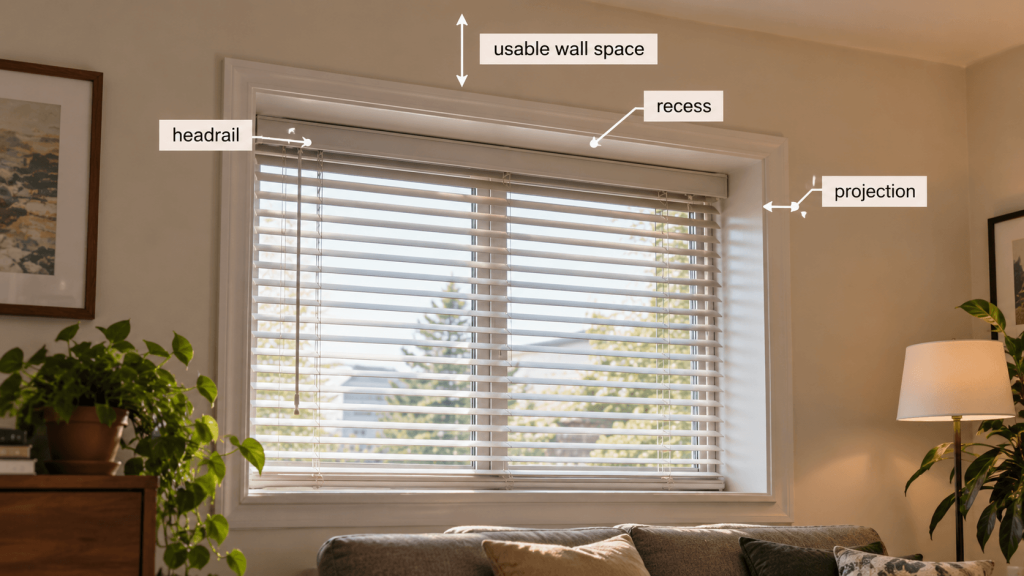
Take one straight-on photo of the whole window before shopping. You are looking for three things: where the blinds are mounted, how far the headrail projects into the room, and where there is actually usable space for curtain hardware.
If the blinds are inside-mounted
The headrail may already occupy much of the window recess. That can eliminate a tension rod before you even compare products.
Look at the strip of flat surface left above or in front of the blinds. If there is barely room for the existing hardware, adding another layer inside the recess is unlikely to be the clean solution it appears to be online.
If the blinds are outside-mounted
You may have more space inside the recess, but the headrail itself projects farther forward.
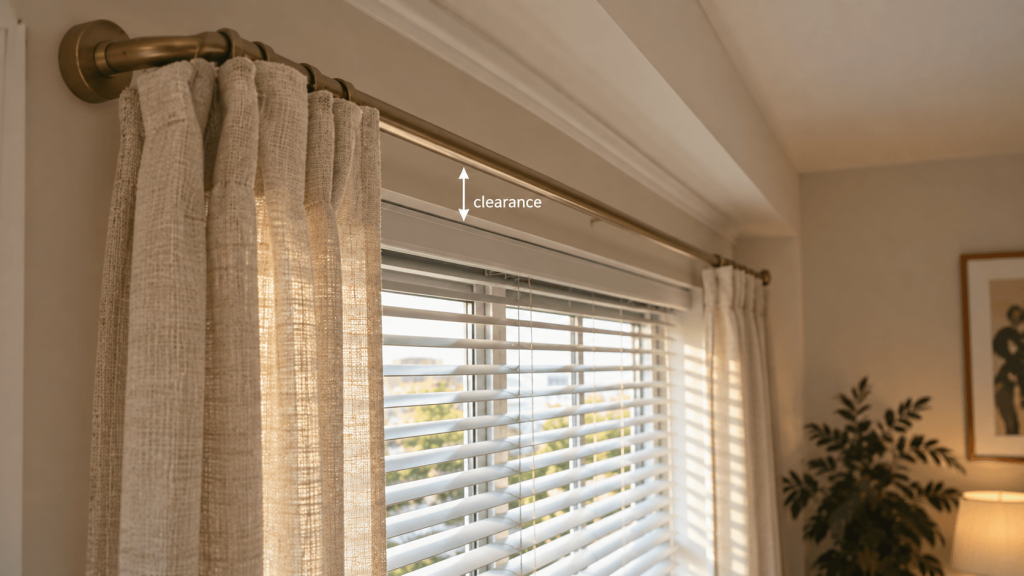
Any curtain hung in front needs enough clearance to avoid resting directly against the blinds or blocking the tilt and lift mechanism you still use.
Then look at the space around the window
Do not start with “Which renter-friendly curtain rod should I buy?”
Start with:
Where could a rod physically go on this window?
A product can be renter-friendly in general and still be wrong for your specific trim, recess, headrail, or curtain weight.
If your rental has vertical blinds instead, the mounting problem is different—start with how to hang curtains over vertical blinds instead.
When Removing the Blinds Makes Sense
Removing horizontal blinds makes more sense when the blinds themselves are the thing you dislike, not just the lack of softness around the window.
It also helps if you expect to stay long enough to enjoy the change.
If you have another two or three years on the lease, changing a prominent living-room window may easily justify the installation and eventual restoration. If you expect to move in a few months, the same project can become a lot of work for a short payoff.
Storage is the less obvious part of the decision.
Before removing anything, know where the full blind, brackets, screws, valance pieces, and small plastic parts will stay until move-out. Do not throw away hardware because it looks replaceable.
If the blinds are removed from an inside mount, you also do not need to “fix” their original mounting holes while you are still renting. You may need those same locations to reinstall the blinds later.
Removing the blinds is therefore a reasonable choice when three things are true: you can store them safely, you can restore the window later, and curtains can take over whatever privacy or light control you still need.
When Keeping the Blinds Is the Better Choice
If the blinds still work, there is nothing wrong with letting them keep doing the practical job.
Blinds handle function. Curtains handle the room.

That can mean leaving the blinds available for daytime privacy and glare control while using curtains to soften the hard lines around the window, introduce fabric, or make the opening feel more finished.
It also avoids finding storage for a long, fragile object that belongs to your landlord.
If privacy is the actual problem rather than the appearance of the blinds, compare privacy window film vs curtains in a rental before adding a second full window treatment.
If the Blinds Stay, Match the Hardware to the Window
There are several no-drill ways to add curtains, but they are not interchangeable.
Headrail-mounted brackets
Start here when the blinds must stay and the existing headrail is compatible.
A bracket that clips onto the headrail can keep new holes out of the wall, but check how far the rod sits forward and whether the blinds can still tilt and raise normally.
This is most convincing with lightweight panels rather than a heavy blackout setup.
Tension rod
Consider this only if the window recess still has a clear, flat strip for the rod.
With inside-mounted blinds, that space is often the first thing to disappear. If the tension rod would need to compete with the headrail for the same few inches, rule it out rather than forcing the fit.
Adhesive brackets
Use the same caution you would with any adhesive attached to painted drywall.
The important distinction is not simply holes versus no holes. It is which option you are more confident you can remove cleanly at the end of the lease.
A small screw hole that can be patched may sometimes be easier to restore than adhesive damage to weak paint. Your lease and landlord rules still decide whether drilling is an option in the first place.
Curtain Weight Can Change the Answer
Lightweight sheers or unlined curtains are relatively forgiving. If their main job is to soften the window, you have more flexibility in how they are supported.
Heavy blackout curtains are different.
The heavier the fabric and the wider the span, the less useful it is to choose hardware simply because it is marketed as no-drill. A mounting method that sags, shifts, or eventually fails under normal opening and closing is not renter-friendly just because it avoided holes.
If blackout is the priority, choose the support first and the “temporary” label second.
Run One Reversibility Check
Before removing the blinds, you should be able to answer five questions without guessing: where every removed part will be stored, whether you can reinstall the blinds with the same hardware, what will provide privacy once they are gone, whether your curtain support can handle the fabric you want, and whether the blinds will remain usable if you keep them.
If two or more answers are still uncertain, work around the blinds first.
You can always remove them later. It is harder to undo a rushed decision after hardware has been lost or a mounting method has damaged the wall.
Three Windows, Three Different Answers
1. Inside-mounted blinds, long lease, removal and drilling allowed
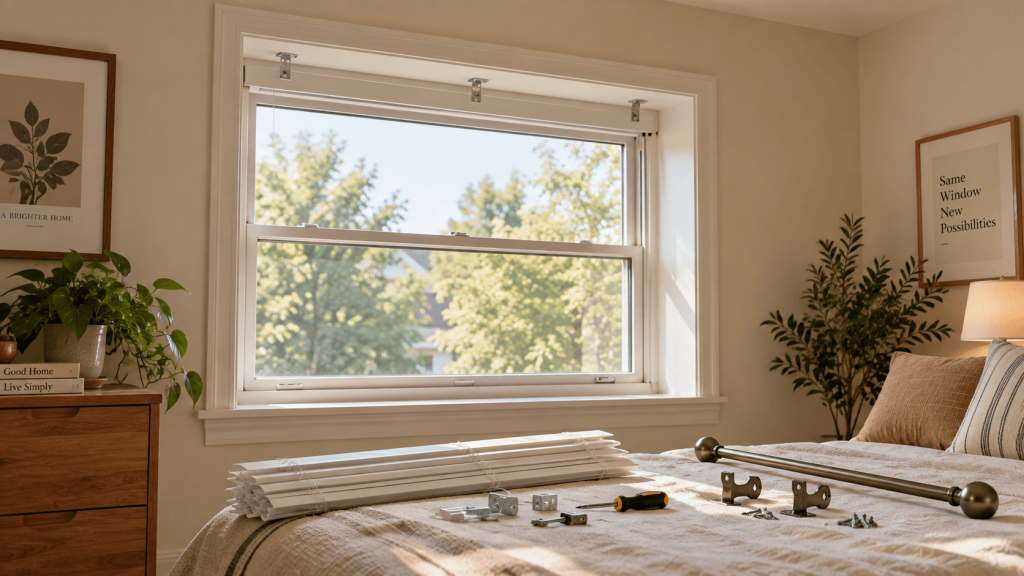
You have two years left on the lease, the blinds are the part of the window you dislike most, and you have somewhere safe to store them.
In this case, removing them is reasonable.
Keep the blind hardware together in a labeled bag and store it with the blinds. If your lease allows ordinary curtain-rod installation, use a standard properly anchored rod rather than building a complicated no-drill setup around hardware you have already decided you do not want.
The first move is simple: remove and store the blinds before shopping for curtains.
2. Working blinds, no drilling, lightweight curtains
The blinds work well, but the window feels hard and unfinished. You want sheers or lightweight linen-look panels, and new wall holes are not allowed.
Keep the blinds.
If the headrail accepts a compatible curtain bracket, that is the first option worth checking because it uses hardware already attached to the window. If it does not, check whether the recess still has enough clear surface for a light tension rod.
If neither condition exists, do not move directly to adhesive just because it is the remaining no-drill option.
The first move here is: check headrail compatibility, then recess space, in that order.

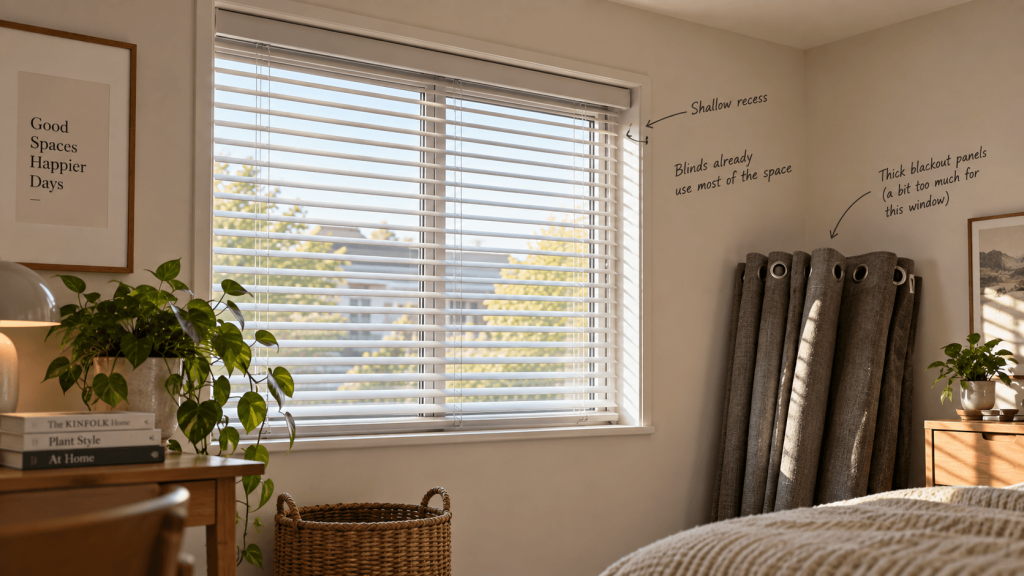
3. Short lease, shallow window, heavy blackout curtains
You have only a few months left, the blinds occupy most of a shallow recess, and the curtains you want are heavy blackout panels.
This is where the project starts asking for more compromise than the window may be worth.
A tension rod has little usable space. A lightweight headrail bracket may not suit the curtain load. Removing the blinds means storing and reinstalling them shortly afterward.
Leave the blinds in place for now and solve the light problem with the least disruptive option available around the existing window.
The first move is: do not build a full curtain installation for a short-term visual upgrade.
Should You Replace the Blinds?
Only if removing them makes the window simpler rather than turning one ugly feature into a storage, mounting, and move-out problem.
The cleanest-looking option is not always the easiest rental decision to undo.
If the window has to stay mostly as it is, explore more ways to work around fixed features in a rental.
FAQ
Do I need landlord permission to remove horizontal blinds?
Check your lease before taking down landlord-owned fixtures. Some leases allow temporary removal as long as everything is restored, while others require approval before changing installed window treatments.
Where should I store blinds after removing them?
Store them somewhere dry where the slats will not bend, ideally with all brackets, screws, and small parts labeled and kept together. Avoid closets where long blinds will constantly be moved around or leaned against.
Is drilling always worse than using adhesive brackets?
Not necessarily from a restoration standpoint. A small permitted screw hole may be straightforward to patch, while adhesive can sometimes damage weak paint during removal; what you are allowed to do is still determined by the lease.
What if I want blackout curtains but cannot drill?
Start with the weight of the curtains and the mounting options your window actually supports. If no no-drill option can carry the panels reliably, changing the curtain type or leaving the existing blinds in place may be more practical than forcing the installation.
Should curtains completely hide the horizontal blinds?
They do not have to. If the blinds still provide useful privacy or daylight control, the curtains only need to reduce their visual dominance and frame the window when open.