Renter-Friendly Curtains: How to Hang Them in a Rental
Renter-friendly curtains start with the window—not the hardware. Use your curtain needs, mounting surface, existing blinds, and move-out plan to choose a setup that actually works.

The curtain panels themselves are usually the easy part of renter-friendly curtains. They can move with you, work in another room, and often survive more than one apartment.
The hardware is where a simple window upgrade gets complicated.
A tension rod may work perfectly in one window and have nowhere useful to sit in another. Adhesive brackets avoid drilling, but they still depend on the mounting surface, the curtain setup, and the product’s installation and removal requirements.
Before you shop, start with three questions: What do you need the curtains to do? What does your window give you to work with? And what kind of support does the full setup need?
The most renter-friendly option is usually the least permanent setup that can reliably do the job.
Quick Take
| YOUR SITUATION | START HERE |
|---|---|
| Lightweight privacy curtains + recessed opening | Check whether a tension rod fits the opening and your intended curtain setup |
| Blackout or heavier curtains | Check the full curtain setup and available mounting support before choosing hardware |
| Existing vertical blinds | Start with our guide to curtains over vertical blinds |
| Existing horizontal blinds | Decide whether the blinds need to stay before choosing a curtain setup |
| No suitable no-drill mounting location | Check whether a standard curtain rod is permitted before buying workaround hardware |
Already know where your curtains can mount? Compare hardware options for your window ↓
What Do You Actually Need the Curtains to Fix?
Before thinking about rods or brackets, decide what job you are giving the curtains.
If privacy is the main goal, start by deciding when you need it and how much visibility you want to block. A lighter curtain may be enough, but choose it for the privacy it actually provides rather than simply because it is easier to hang.
If privacy matters more than softness or blackout, curtains may not be the only option. Compare the tradeoffs in our guide to privacy window film vs. curtains in a rental.
If you want stronger light control or blackout, the setup becomes more demanding. Panel size, coverage around the window, fabric construction, rod span, and how often you open and close the curtains can all affect which mounting options make sense.
If the room simply feels hard or unfinished, the curtains may only need to soften the window. Decorative panels can add fabric and visual weight without taking over the practical job of existing blinds.
And if the real problem is that you hate looking at landlord-installed blinds, that is a different starting point. Your curtain now has to work around something already attached to the window rather than simply cover an empty opening.
Decide what the curtain needs to accomplish first. The hardware choices become much easier to narrow down after that.
Before You Buy a Rod, Look at the Window You Already Have
Renter-friendly curtain hardware can look surprisingly interchangeable online. At the actual window, small differences in the opening, trim, wall surface, and existing blinds quickly rule options in or out.
Is there a usable recess?
A tension rod needs two usable opposing surfaces and enough clear space between them.
A deep, simple window opening may make that easy. A shallow recess already occupied by blind hardware may leave little room for another rod, even though the window technically has an inside mount.
Check the space that is actually available rather than assuming every recessed window can take a tension rod.
What surrounds the window?
Look at what you would actually be attaching hardware to. Depending on the rental, that may be painted drywall, wood trim, tile, metal, or a combination of several materials.
Different mounting systems depend on different conditions. A trim-mounted bracket is irrelevant if there is no compatible trim. A magnetic system only helps where there is an appropriate metal surface. Adhesive hardware still needs a surface approved for the specific product.
Use this first check to rule out hardware that clearly does not match your window before comparing products.
Are existing blinds already using the obvious mounting space?
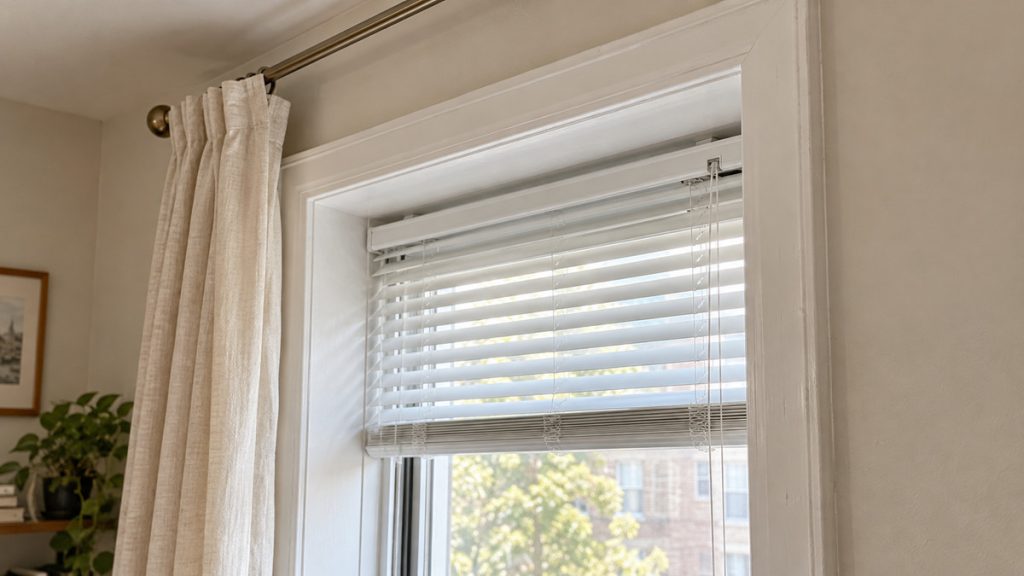
Inside-mounted blinds can take up much of the recess. Outside-mounted blinds may project forward from the wall or trim and change how far a curtain rod needs to sit from the window.
Also check what still needs to move after the curtains go up. The blinds may need to tilt, raise, slide, or stack, and the window itself still needs to open normally.
A curtain setup that technically fits but interferes with something you use every day has not really solved the window.
Before shopping, record a few basics:
- the width of the proposed mounting location;
- the usable depth of the recess, if you are considering an inside mount;
- how much space the existing blinds or headrail occupy;
- anything that needs clearance to move, open, tilt, or stack.
Take one straight-on photo and one side-angle photo too.
You do not need a complete installation plan yet. You just want enough information to compare your real window with the requirements of the hardware you are considering.
Match the Mount to the Curtain, Not Just the Rental
Once you know what the window can realistically accommodate, compare the mounting options on the same terms.
| MOUNTING OPTION | WHAT THE WINDOW MUST PROVIDE | WHAT TO VERIFY | MAIN TRADEOFF |
|---|---|---|---|
| Tension rod | A usable recessed opening with opposing surfaces | Opening dimensions, rod fit, and requirements for the complete curtain setup | Limited by the shape, depth, and available space in the recess |
| Adhesive hooks or brackets | A compatible mounting surface | Approved surfaces, installation method, removal method, and product limits | Suitability depends heavily on the specific surface and product |
| Trim-mounted no-drill bracket | Compatible window trim | Required trim material, shape, dimensions, and attachment method | Some systems attach with small pins, so “no-drill” does not necessarily mean no trace at all |
| Magnetic rod or bracket | An appropriate metal mounting surface | Whether the surface and hardware are compatible with the intended curtain setup | Only useful where suitable metal is available |
| Compatible blind-mounted attachment system | A compatible blind headrail or existing blind system | Exact headrail compatibility, clearance, and normal blind operation | Highly dependent on the blind system already installed |
| Standard curtain rod | Permission plus a suitable mounting location | Rental rules, installation requirements, and move-out restoration | More permanent and may leave repair work when you move |
Think of this table as a filter rather than a ranking.
A tension rod can be an excellent rental solution when the window gives it a good place to sit. If the recess is shallow, crowded with blind hardware, or otherwise unsuitable, the fact that the rod requires no drilling does not make it a good fit.
With adhesive hardware, compare the requirements for the exact product with your mounting surface and complete rod-and-curtain setup. Products within the same broad category can have different approved surfaces, dimensions, and limits, so “adhesive curtain bracket” is not enough information by itself.
Trim-mounted and blind-mounted systems can be useful because they take advantage of something already at the window. Their usefulness depends on compatibility, though. Some trim-mounted products, for example, secure themselves with small pins rather than conventional screws, while blind-mounted attachments may be designed around particular headrail shapes or sizes.
Sometimes this comparison ends without a new product in your cart. Reusing something already at the window, choosing a different curtain setup, checking whether a conventional rod is allowed, or leaving the window alone for now can all be reasonable outcomes.
Window-first shopping notes
Hardware to Check for Your Mounting Location
These are examples for three different window conditions, not a ranked list. Check the exact product specifications against your window, rod, and curtain before ordering.
Kenney Strafford Spring Tension Rod
Worth checking when you have a clear inside-mount opening and want to hang lightweight curtain panels or sheers.
Verify: 28–48 in. opening fit, stable opposing surfaces, and the weight requirements for the exact rod and panels.
Check on Amazon →Command Curtain Rod Hooks (17654)
An adhesive option when your mounting surface and complete curtain setup meet the manufacturer’s requirements.
Verify: approved surface, 0.5–0.75 in. rod diameter, up-to-48-in. rod length, stated load limits, and removal instructions. Not for textured walls or wallpaper.
Check on Amazon →Kwik-Hang Single Curtain Rod Brackets
Only relevant if the window has compatible traditional wooden trim and small pin marks are acceptable under your rental rules.
Verify: trim dimensions and material, rod diameter, support needs, and pin-based attachment. Not intended for MDF, PVC, metal, or oak trim.
Read manufacturer specs →No purchase needed? If compatible hardware is already in place—or none of these conditions matches your window—it’s fine to leave the shopping list empty.
Need Blackout Curtains? Check the Whole Setup
Blackout curtains can change the decision because stronger light control often requires more than adding opaque fabric to the window.
You may need wider panels, more coverage beyond the opening, or a setup that sits farther outside the glass. Those choices affect the complete installation, including the rod and the hardware supporting it.
Start with the amount of light control you actually need.
If you mainly want to reduce morning glare or soften bright afternoon light, a full blackout installation may be unnecessary. A simpler curtain or another light-control solution may solve the problem with fewer mounting constraints.
If you need the room substantially darker, look at coverage as well as fabric. Even an opaque curtain can leave obvious light around the top or sides when the panels do not extend far enough beyond the opening.
Then compare the complete setup with the mounting locations you identified earlier.
If one of those locations works with the curtain setup you need, choose the least permanent suitable option. If none does, simplify the curtain setup, check whether a conventional rod is allowed, or decide that forcing a no-drill installation onto this particular window is not worth the compromise.
If the window already has vertical blinds and the real problem is light leaking through or around them, start with our guide to adding blackout around existing vertical blinds instead. That is a narrower problem than choosing renter-friendly curtains in general.

Already Have Blinds? Start With That Constraint
Landlord-installed blinds change both the mounting space available to you and what the curtain needs to work around.
With vertical blinds, the headrail, vane movement, stacking area, and clearance in front of the blinds all matter. Start with our guide to hanging curtains over vertical blinds before choosing general curtain hardware.
With horizontal blinds, first decide whether they actually need to come down. Our guide to replacing horizontal blinds with curtains in a rental covers the choice between keeping the blinds in place and temporarily removing them.
And if the vertical blinds work properly but you mainly dislike how they look, start with ways to deal with ugly vertical blinds in a rental. Curtains are only one possible answer.
Treat the existing blind system as part of the window rather than something you can ignore while shopping for curtain hardware.
“No-Drill” Does Not Automatically Mean “No-Damage”
“No-drill” tells you that a mounting system does not require conventional drilling. It does not tell you whether that system is suitable for your paint, trim, wall texture, window frame, or curtain setup.
Adhesive hardware is a good example. A product may be designed to remove cleanly when it is installed on an approved surface and removed according to its instructions, but that does not make every painted rental wall an appropriate surface.
Paint condition, surface texture, installation method, and removal technique can all affect the result. Check the instructions for the exact product instead of assuming a damage-free claim applies to every wall.
Other no-drill systems have their own conditions too. A tension rod depends on pressure against the surfaces holding it, while some trim-mounted products use small pins in the trim rather than screws in the wall.
Before installing anything, check four things:
- what surface or window condition the hardware is designed for;
- how it actually attaches;
- what the manufacturer requires for your intended setup;
- how it is supposed to come back off.
A renter-friendly setup should be reasonable to live with while you are there and reasonable to undo when you leave.
When a Regular Curtain Rod May Be the Simpler Choice
There is a point where avoiding every possible hole can make a curtain project more complicated than it needs to be.
If your lease, building rules, or landlord allow a standard curtain rod, include it in the comparison. A conventional rod may provide better placement and more flexibility than buying highly specific workaround hardware that only fits this apartment.
Permission comes first, so check the lease and any relevant building rules before changing the window area. If the rules are unclear, ask the landlord or property manager instead of assuming that a small installation is automatically allowed.
Then think about move-out.
If a standard rod is permitted but the wall needs to be restored later, that work belongs in the real cost of the project. It may still be simpler overall when the alternatives are expensive, poorly suited to the window, or unlikely to be useful after you move.
Compare the setups you are actually allowed to use rather than treating “drilling” and “no drilling” as the entire decision.
Before You Buy, Check the Full Setup
Before ordering anything, run through the complete window once.
What problem am I solving?
Privacy, stronger light control, visual softness, and hiding existing blinds can lead to different curtain setups.
Where can the curtain realistically mount?
Compare the hardware with the actual recess, trim, wall surface, blinds, and clearance around your window.
Have I checked the hardware requirements against the complete rod-and-curtain setup?
Use the requirements for the exact product rather than assuming everything in the same hardware category works the same way.
Do the existing blinds need to keep working?
If they do, make sure the new curtain leaves enough room for normal blind and window operation.
Would I want to use these curtains again after I move?
Curtains that can follow you to another home are easier to justify than highly window-specific hardware you may never use again.
What will I need to undo at move-out?
Think about hardware removal, landlord-owned pieces you need to store, marks or holes, adhesive removal, and any restoration your rental agreement requires.
The goal is not to create the most temporary curtain setup possible. Choose curtains you would be happy to keep, confirm that your current window can support the complete setup, and use the least permanent mounting method that can do the job reliably.
That is a more useful way to think about renter-friendly curtains.
FAQ
What curtains are best for renters?
Look for curtains that solve the problem you actually have and that you would be happy to use again in another home. Privacy, blackout, decorative softness, and covering existing blinds can require different setups, so there is no single best curtain type for every rental.
How can renters hang curtains without drilling?
Depending on the window, options may include tension rods, compatible adhesive hardware, trim-mounted systems, magnetic hardware, or attachments made for certain blind systems. Start with the mounting conditions at your window, then compare them with the requirements of the specific hardware.
Can Command hooks hold curtains?
Command makes curtain-rod hooks for specific applications, but the exact product instructions still matter. Check the listed mounting surfaces, rod size, load limits, installation steps, and removal instructions for the product you are considering rather than assuming any Command hook can support a curtain rod.
Can renters hang blackout curtains without drilling?
Sometimes. Define the complete blackout setup first—including coverage around the window—then compare it with the mounting locations available to you. If the suitable no-drill options do not work with that setup, simplifying the curtain plan or checking whether a standard rod is permitted may make more sense.
Can you put curtains over apartment blinds?
Often, but the blinds change the available mounting space and clearance. Vertical and horizontal blinds create different constraints, so start with the blind system already installed before choosing general curtain hardware.
Do you need landlord permission to install curtain rods?
Check your lease and building rules before installing a conventional curtain rod. Requirements vary by rental, so if the rules are unclear, confirm what is allowed and whether any restoration will be expected when you move out.