Ugly Vertical Blinds in a Rental? 5 Ways to Deal With Them
Hate the vertical blinds in your rental? Compare 5 realistic options—from curtains and workarounds to removing them or leaving them alone.
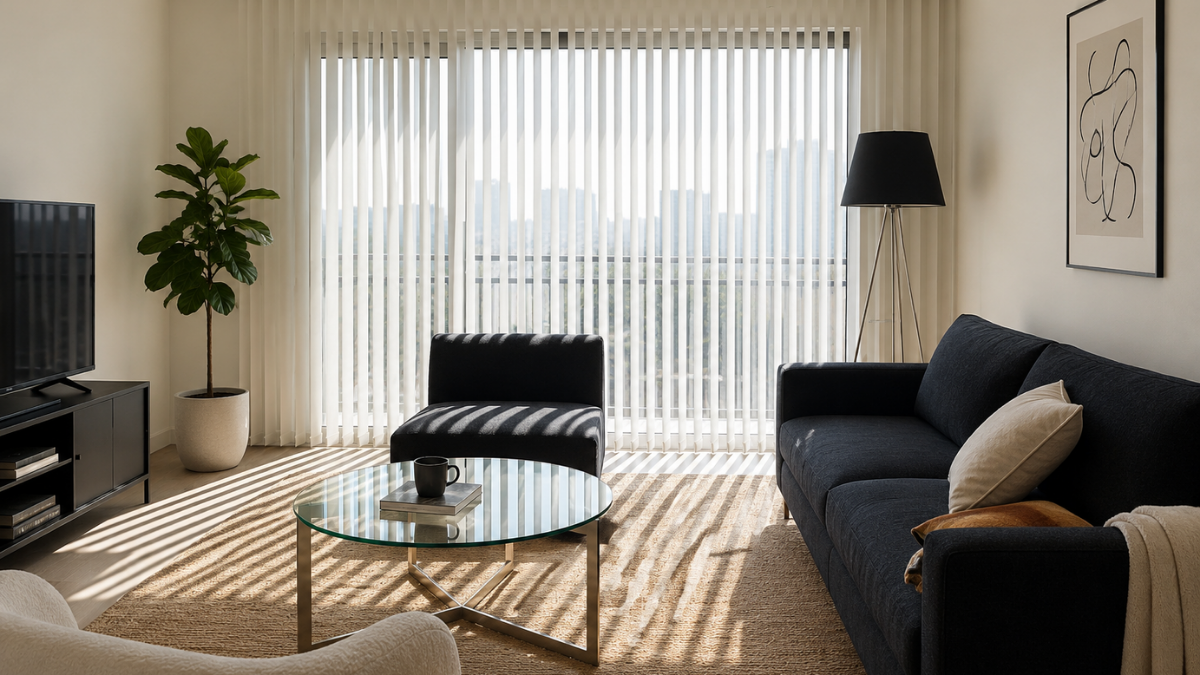
Ugly vertical blinds in a rental do not automatically need to come down. If they still work, you can usually hide them with curtains, work around them, temporarily remove them, or simply leave them alone.
The right choice depends on what actually bothers you, how visible the window is, how reversible the fix is, and how long you expect to stay.
Start by figuring out whether the blinds are just ugly—or whether they are actually broken.
First, What Do You Actually Hate About the Blinds?
Not all “ugly vertical blinds” are the same problem.
Maybe it’s the plastic slats that make the room feel like an office. Maybe the bulky track is what catches your eye. Maybe the blinds are an awkward beige that doesn’t work with anything else in the room.
Or maybe they’re not just ugly at all. They’re missing slats, getting stuck, or no longer closing properly.
That distinction matters.
If the blinds work fine but look dated, you’re dealing with a decorating decision. If they’re broken enough that they no longer provide the privacy or light control they’re supposed to, it may be worth contacting your landlord before spending your own money.
There isn’t one best renter-friendly fix. What makes sense depends on the visual payoff, the cost, how easy the change is to undo, and how long you’ll actually get to enjoy it.
Option 1: Hide the Vertical Blinds
For a lot of renters, this is the most practical middle ground.
The vertical blinds stay where they are and keep doing their job, while curtains in front make them much less visible.
This works especially well on a large window or sliding glass door where the blinds dominate the room. Curtains also add something vertical blinds usually don’t: softness. Even simple fabric panels can make a window feel less like it came straight from an apartment leasing office.
You don’t necessarily need to drill into the wall, either. Depending on your window and existing blind track, there are brackets designed to work with some vertical blind headrails, along with tension-mounted and other removable curtain systems.
Just don’t buy something solely because the packaging says “no-drill” or “renter-friendly.” Check the measurements, mounting method, curtain weight, and whether the system will actually work with your particular window.
Hiding the blinds is probably worth considering if:
- they still work properly;
- the window is a major part of the room;
- curtains would improve the room beyond simply hiding the blinds;
- you can buy curtains you’d happily use again somewhere else.
It becomes harder to justify if the window needs expensive custom panels or hardware you’re unlikely to use after moving.
If this sounds like the right option, start by checking your window measurements, blind track, and the mounting options that will actually work with your setup.
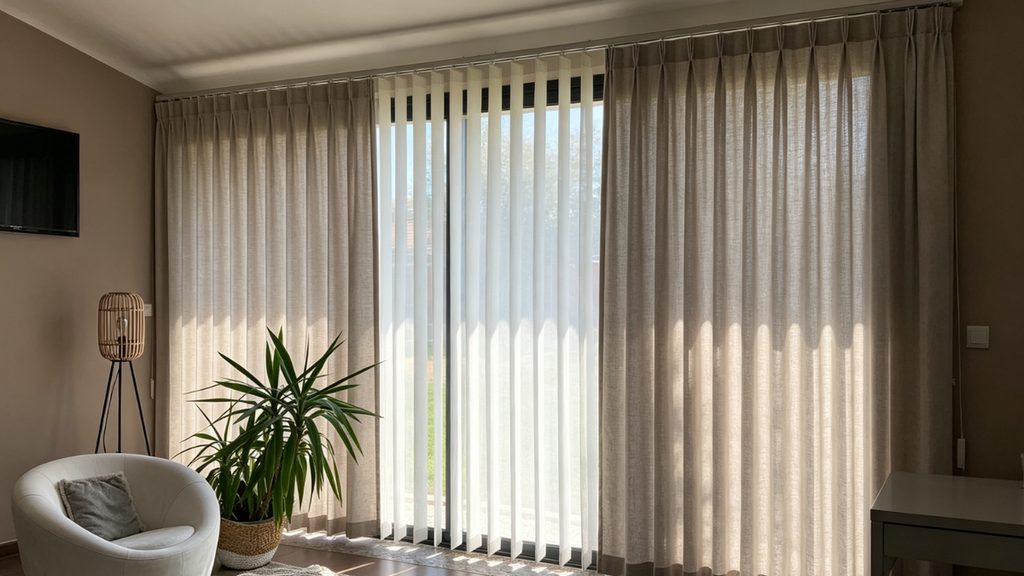
If you want to keep the blinds in place but soften the window with fabric, the next question is how to hang curtains over vertical blinds without stopping them from working.
If the blinds themselves are not the problem but the room is still too bright when they are closed, treat that as a light-control problem instead. You can add blackout without removing the vertical blinds, but where the light leaks matters more than the label on the curtain.
Option 2: Work Around Them
Before buying anything for the window, try asking:
What if the blinds didn’t have to disappear?
Neutral vertical blinds often look worse when the rest of the room is sparse, cool, or equally hard-edged. In that situation, the blinds can end up carrying more visual weight than they deserve.
A rug, warmer lighting, artwork, plants, cushions, or softer fabrics elsewhere in the room may pull attention away from the window enough that the blinds stop feeling like the problem.
You can also repeat their color elsewhere.
If your rental came with cream blinds, for example, adding another warm neutral or two can make them feel less accidental. You’re not trying to match your entire room to the blinds—just giving that color somewhere else to belong.
This approach has another advantage: almost everything you buy belongs to you, not the apartment.
A floor lamp can move with you. So can a rug, artwork, cushions, and most textiles. Money spent making the whole room better is often easier to justify than money spent solving one landlord-owned window.
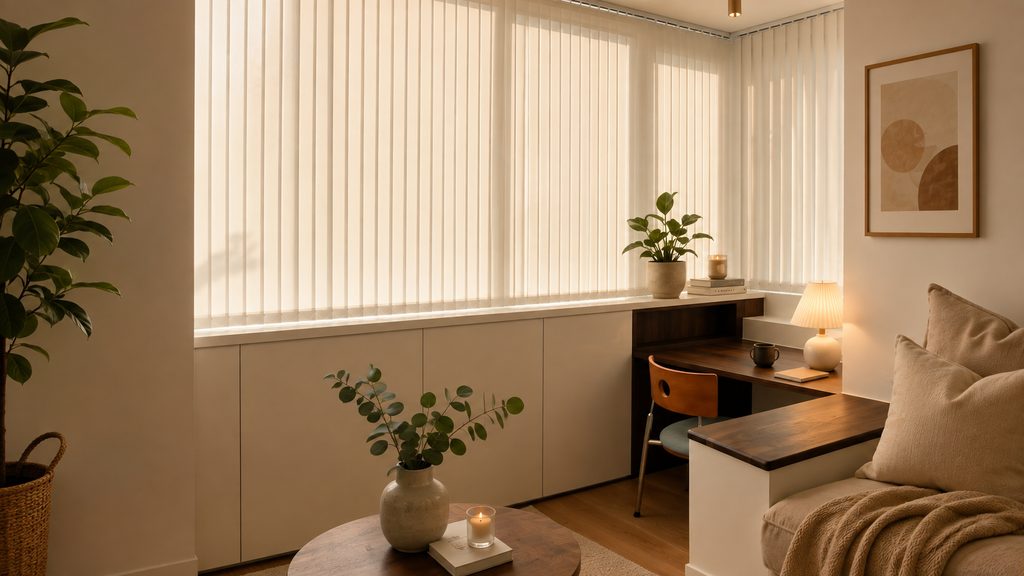
Option 3: Temporarily Replace the Vertical Blinds
If you are looking for vertical blind alternatives, first decide whether you actually need a different window treatment or simply want the existing blinds to disappear from view.
Depending on the blind system, individual vertical slats may be removable while the headrail stays in place. Some setups allow more of the existing treatment to be taken down.
The part that looks easy in a before-and-after photo is the removal.
The part worth thinking about is everything that happens afterward.
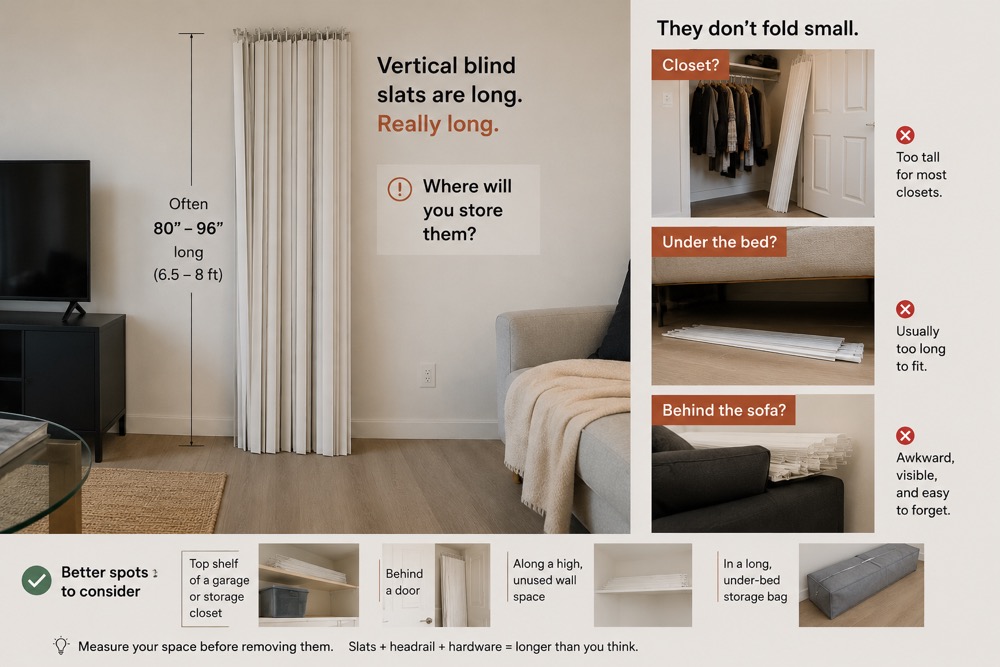
Where will you store them?
Vertical blind slats are long and awkward. If you have 20 or 30 of them, “I’ll just put them somewhere” can become surprisingly inconvenient in a small apartment.
Can you keep every original part?
Clips, chains, weights, brackets and other hardware are easy to lose over a long lease. Keep anything you remove together and clearly labeled.
Can you put everything back?
Assume that future-you will have to reverse the project at move-out.
That doesn’t make removal a bad idea. It just means the reinstall should be part of the decision you make now.
How old are the blinds?
Older plastic parts can become brittle. A clip that has spent years in direct sunlight may not survive being handled as well as a brand-new one in a tutorial video.
Before removing a landlord-owned window treatment, check your lease and ask for permission if needed. Photographing the original setup before you touch anything is also a good idea.
If this is your main living room and you expect to stay three years, all of that effort may feel completely reasonable.
If your lease ends in eight months, probably less so.
Option 4: Ask the Landlord
There’s an important difference between:
“I hate these beige blinds.”
and:
“These blinds are missing several slats and won’t close.”
The first is mostly a decorating problem.
The second may be a functional or maintenance problem.
If the blinds are damaged, difficult to operate, or no longer provide the privacy or light control they were intended to provide, document the issue and contact your landlord or property manager before replacing them yourself.
If privacy—not the blinds themselves—is the real problem, window film and curtains solve that problem in very different ways.
Exactly what a landlord is responsible for varies by lease and location, so don’t assume that old or unattractive blinds automatically qualify for replacement.
But don’t automatically pay to fix landlord-owned equipment that isn’t working properly, either.
Sometimes the cheapest renter-friendly solution is an email.
Option 5: Leave Them Alone
This one rarely makes it into lists of rental makeover ideas because there isn’t much to photograph afterward.
There’s also nothing to buy.
But some vertical blinds simply aren’t worth fixing.
Imagine you have five months left on your lease. The blinds work. They’re ugly, but they sit behind your sofa and you mostly stop noticing them once the room is furnished.
You could measure the window, research curtain hardware, order everything, install it, enjoy it for a few months, remove it again, and restore the window before moving.
Or you could spend that money on something you actually want to take with you.
Leaving the blinds alone makes more sense when:
- you expect to move soon;
- the window isn’t a major focal point;
- the blinds work properly;
- covering them requires unusual dimensions or expensive hardware;
- another problem in the room bothers you much more;
- most of the solution would stay behind or become useless after moving.
This is one of the easiest traps in rental decorating: seeing something ugly and assuming it automatically deserves a project.
It doesn’t.
If the room is dark, uncomfortable, badly laid out and has ugly vertical blinds, a good floor lamp may improve your everyday life much more than hiding the blinds.
Which Option Is Actually Worth It?
Here’s how the five approaches compare:
| Option | Visual Impact | Cost | Reversible | Moveable | Effort |
|---|---|---|---|---|---|
| Hide with curtains | High | Low–Medium | High | High | Medium |
| Work around them | Medium | Low | High | High | Low |
| Temporarily replace | High | Medium–High | Medium | Medium | High |
| Ask the landlord | Varies | Usually Low | — | — | Low |
| Leave them alone | None | None | — | — | None |
There’s one more column that doesn’t fit neatly into the table:
How long are you staying?
That can change the answer completely.
If you’re weighing the cost against how long you’ll stay, our Worth It? framework can help you make the call.
How Long Are You Staying?
Less than 6 months
Keep the bar high.
Unless the blinds are creating a real privacy or usability problem, Leave Them Alone or a very low-effort Work Around will usually make more sense.
If you buy anything, favor things you already want for your next home.
6 to 18 months
This is where Moveability becomes especially useful.
Standard curtain panels you love and can take with you? Reasonable.
An expensive setup sized specifically for one unusually wide sliding door? Much harder to justify.
A useful question here is:
Am I buying this for myself, or for this apartment?
18 months to 3 years
Higher-effort changes become easier to justify.
If the blinds cover an entire wall in a room you use every day, two years of enjoying a better-looking window can be worth some installation and move-out work.
3+ years
At this point, “but it’s only a rental” shouldn’t end the conversation.
You still want changes to be reversible and financially sensible, but living with something you strongly dislike for four years has a cost too.
A rental doesn’t have to be permanent for your daily experience of it to matter.
This is why the cheapest option isn’t always the smartest one.
A $100 pair of curtains you genuinely like and use again in your next apartment may be a better rental purchase than a $60 temporary covering that takes hours to install and goes in the trash when you move.
What Would We Do?
If the blinds still work, we’d start with Work Around.
Finish the room first. Fix the lighting. Add the rug you actually want. Arrange your furniture. Live with it for a little while.
Then look at the window again.
If the vertical blinds are still one of the first things you notice, Hide is probably the next option worth exploring. Curtains can make a big visual difference without requiring you to take responsibility for storing the landlord’s blinds, and standard curtain panels have a reasonable chance of working in your next home.
We’d only move to Temporarily Replace when the visual payoff is high, the remaining lease is long enough, there’s somewhere sensible to store the original blinds, and the change is permitted.
And if the blinds don’t actually work?
Ask the landlord first.
If changing the blinds feels like too much project for too little payoff, explore more ways to work with fixed rental features instead.
Frequently Asked Questions
Can you put curtains over vertical blinds in a rental?
Often, yes. Depending on your window and existing blind system, you may be able to hang curtains in front of vertical blinds using compatible brackets, tension-mounted hardware, or another removable setup.
Measure carefully and check weight limits and compatibility before buying. A product being advertised as “no-drill” doesn’t mean it works with every vertical blind track.
Can you remove vertical blinds in a rental?
It depends on your lease and landlord.
If you’re allowed to remove them temporarily, photograph the original setup and keep all slats and hardware somewhere safe. Plan on restoring the window to its original condition when you move unless you’ve agreed otherwise with your landlord.
What if I have nowhere to store the vertical blinds?
Then removing them may not be the best solution.
Storage is part of the real cost of a temporary rental change. If the original blinds would spend the next two years taking up space behind your sofa, hiding them while leaving them installed may be much easier.
Are curtains worth buying if I’m only renting for a year?
They can be.
The better question is whether you’re buying curtains for this particular rental or curtains you’d be happy to own after you move.
Standard sizes, versatile colors, and styles you genuinely like tend to make more sense than highly customized window treatments for a short lease.
What are the best alternatives to vertical blinds in a rental?
Curtains are usually the easiest alternative when the existing blinds still work because you can leave the landlord’s window treatment in place. If you are allowed to remove the blinds temporarily, other replacement window treatments may also work, but storage, mounting, cost, and move-out restoration become part of the decision.
If the blinds themselves still work, start by deciding whether you actually need to replace them or simply hide them.
The Bottom Line
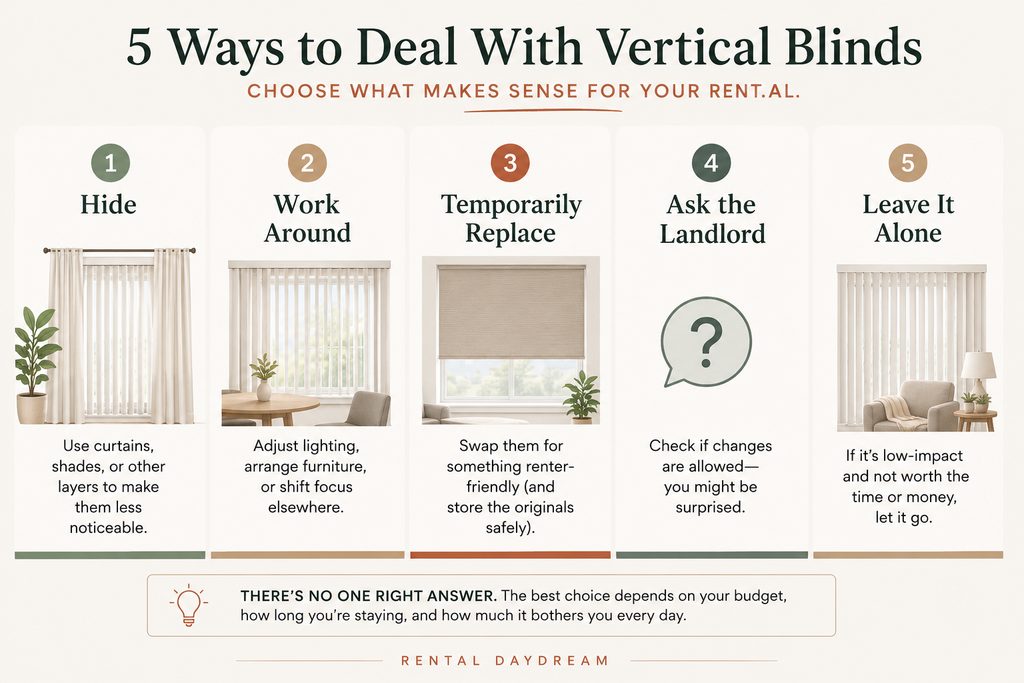
You have five basic ways to deal with ugly vertical blinds: hide them, work around them, temporarily replace them, ask the landlord, or leave them alone.
Start with what actually bothers you. Then look at the visual impact, total cost, reversibility, moveability, effort, and how much time you have left in the rental.
If you decide to spend money, try to put more of it into things that improve your life now and can follow you to your next home.
That’s usually a better rental decision than fixing every ugly thing simply because you can.