Ugly Rental Bathroom? What Should You Actually Change?
Planning a renter-friendly bathroom makeover? Find the change with the biggest impact first, then decide what to work around, cover, or leave alone.
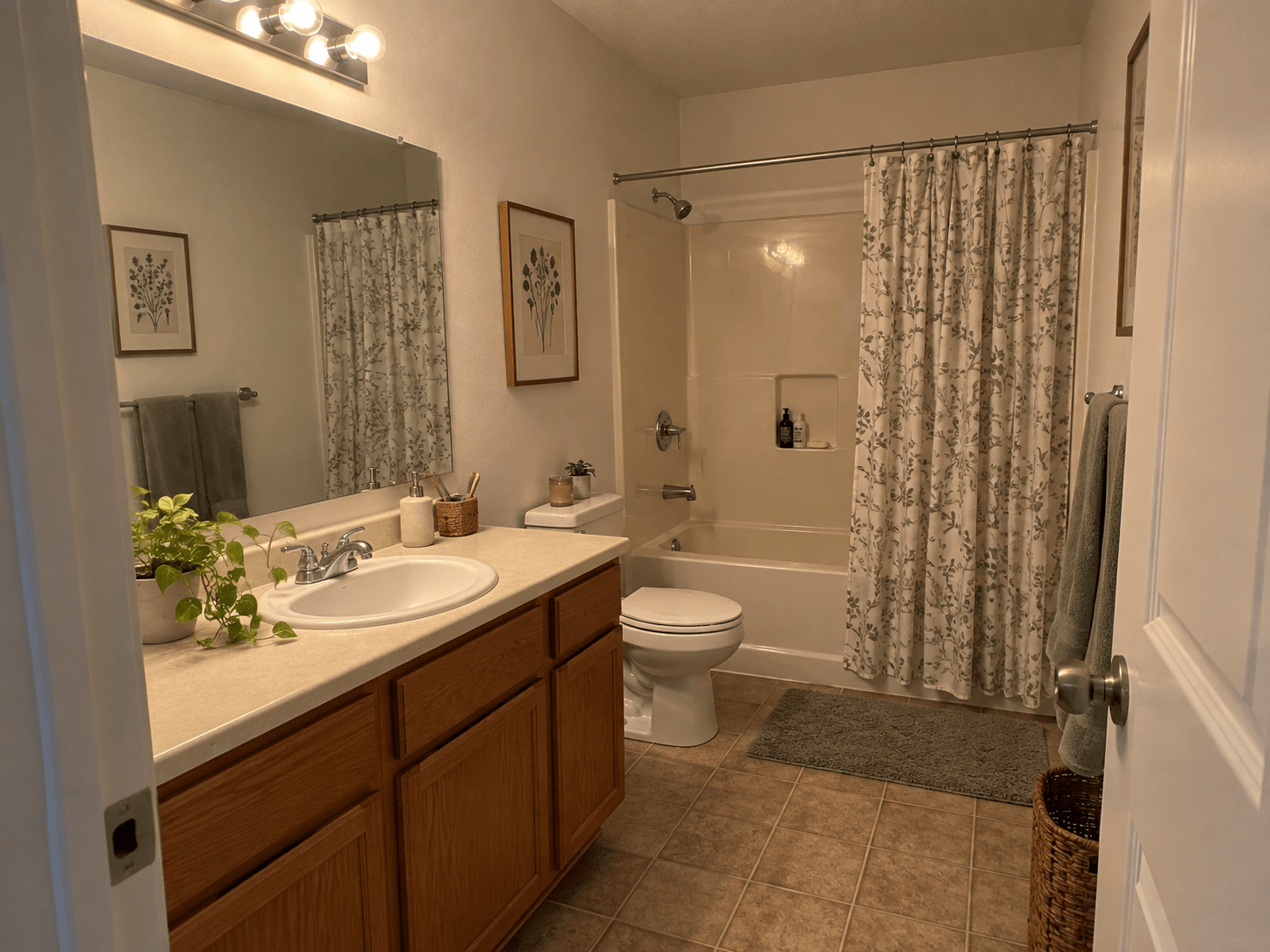
A renter-friendly bathroom makeover does not have to mean changing every surface. Start by finding the one feature that carries the most visual weight, then see whether a simpler, reversible change is enough to fix it.
The floor, vanity, mirror, lighting, and shower area may all bother you, but five things you dislike do not automatically justify five projects.
The useful question is: Which change would make the biggest difference—and how much work is that difference actually worth?
Quick Take
What Makes a Bathroom Makeover Renter-Friendly?
A renter-friendly bathroom makeover does not have to mean changing everything with removable products.
The easiest changes usually fall into three groups:
- Movable: shower curtains, bath mats, storage, art, and accessories
- Reversible: some hardware, showerheads, lighting changes, or other items that can be restored later
- Surface projects: temporary flooring, coverings, or peel-and-stick materials that create more installation and removal work
Start with the first category that has a realistic chance of fixing what bothers you. Move toward the harder categories only when the easier changes do not solve enough.
First, Separate Ugly From Something That Needs Fixing
Before deciding what to decorate around, make sure you’re actually looking at a decorating problem.
Old grout you don’t like is one thing. Grout or caulk that is failing is another.
A vanity in a finish you would never choose is an aesthetic problem. A vanity with a broken door, water damage, or a leaking fixture is not something you should have to disguise with baskets and nicer hardware.
The same goes for peeling paint that may be related to moisture, damaged flooring, loose fixtures, or anything electrical or plumbing-related that isn’t working properly.
If something appears damaged, leaking, failing, or affected by moisture, document it and follow whatever maintenance process your lease or landlord provides before building a makeover around it.
You may still dislike the bathroom afterward. But at least you’ll be judging the room as it’s supposed to function—not trying to decorate around a repair problem.
Once that’s out of the way, you can look at what’s actually bothering you.
Stand at the Doorway: What Do You Notice First?
Before you search for bathroom ideas, stand at the doorway and look at the room as it is.
Where does your eye go first?
Maybe it’s the floor. Maybe it’s a dark vanity, a huge plain mirror, the shower area, or wall tile that seems to take over the room.
You don’t need to make a complete list. In fact, the list can make the decision harder because everything you dislike starts to feel equally important.
Instead, try taking one ordinary photo from the doorway.
No wide-angle lens. Don’t clear the counters or move things around first. You’re not trying to make the bathroom photograph well.
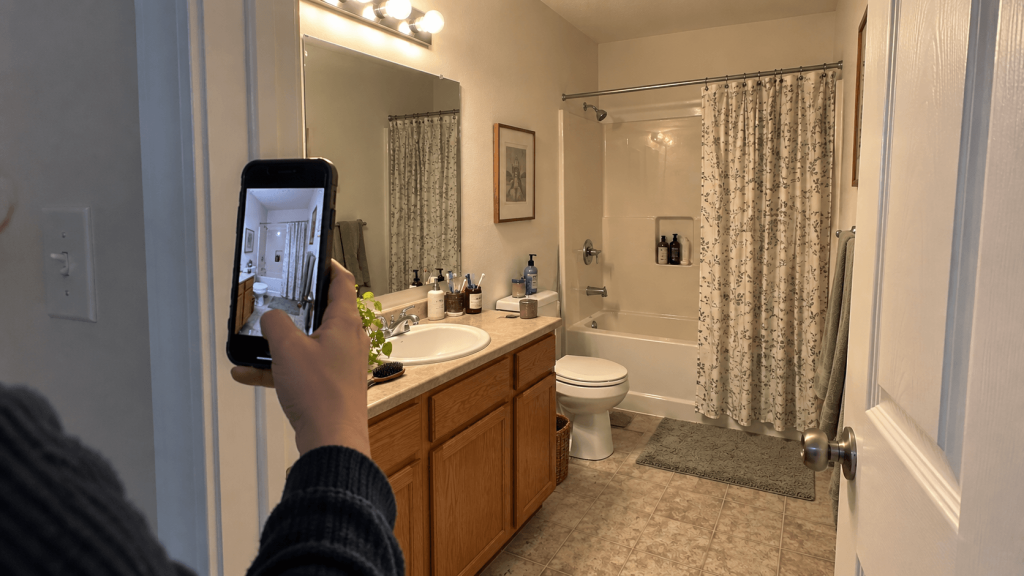
Look at the picture and ask:
If I could make one thing disappear from this image, what would I remove first?
A photo can make visual weight easier to see. That busy floor may be pulling your attention across the entire bottom of the room. Or you may realize the vanity is taking up far more of the view than the tile you’ve been thinking about covering.
If the vanity is clearly the feature carrying most of the problem, do not treat it as one surface. Ugly Rental Bathroom Vanity? Which Part Should You Actually Change? breaks it down into the countertop, cabinet, and small details before you choose a fix.
Sometimes the result is less obvious.
You might look at the photo and realize that the permanent finishes aren’t actually what your eye goes to first. It’s the shower curtain. Or everything on the countertop. Or a bright bath mat sitting in the middle of several already-competing colors.
That’s useful information too.
A list tells you how many things you dislike. A photo can help show you which one is dominating the room.
Just don’t assume the first thing you notice is automatically the first thing you should change.
For now, it’s only your best suspect.
Is That Feature the Problem—or Is It the Combination?
Suppose the first thing you notice is the wall tile.
It’s dated, it covers a lot of the room, and you’re already imagining what you could put over it.
Before you do, ask a slightly different question:
Would I still hate this tile if the things around it changed?
Maybe the tile is blue. That wouldn’t have been your choice, but blue tile by itself isn’t necessarily what makes the bathroom feel wrong.
It could be the blue tile next to a green patterned floor, under a harsh cool light, with a gray bath mat and another strong color in the shower curtain.
None of those things has to be terrible individually. The combination can be the problem.
This is why the largest surface isn’t automatically the one you should tackle first.
Sometimes two things clash more than either one is ugly.
Before physically covering a fixed feature, change its context.
Take the bath mat out of the room for a minute. Pull back or temporarily remove the shower curtain. Clear the countertop. If the lighting makes every surface look flat or unpleasant, see how the room looks under a different light before deciding the finishes themselves are hopeless.
If the shower enclosure is the one feature you keep noticing, treat it as its own problem before changing the rest of the room. Start by deciding whether the glass, the frame, or the whole shower enclosure is actually bothering you.
If the shower itself works but the spray or reach is what bothers you, decide whether replacing the rental showerhead is actually worth it before treating it as another bathroom project.
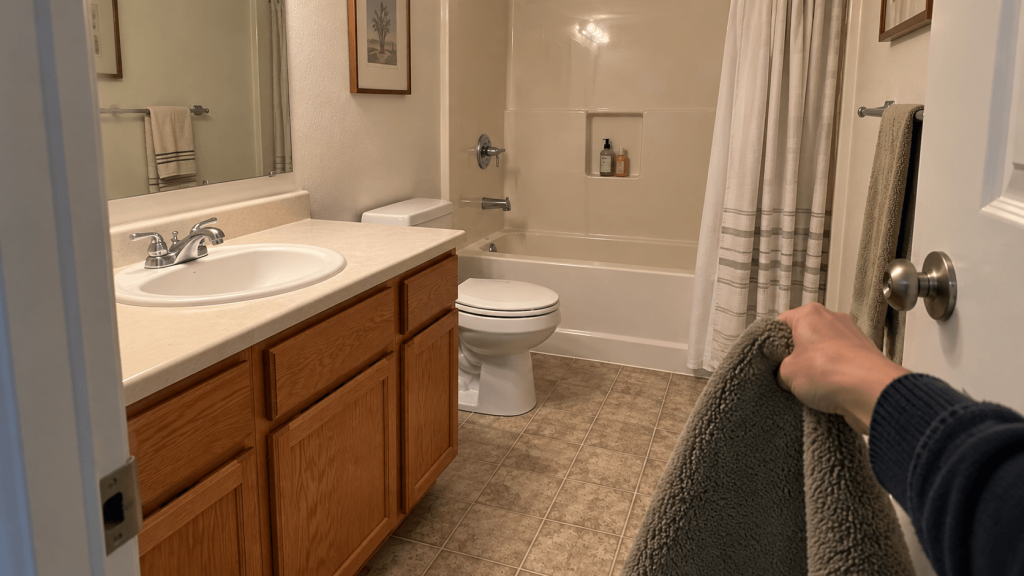
You don’t have to strip the bathroom bare or restyle everything.
You’re only trying to answer one question:
Does this feature still bother me when the easiest competing element is gone?
If the answer is yes, you’ve learned something.
If the tile is staying but still controls the room, start with how to make old rental bathroom tile matter less before assuming it needs to be covered.
If the answer is suddenly “not nearly as much,” you’ve learned something more useful.
Start With the Change That Has the Most Leverage
Once you have a better idea of what’s driving the room, don’t start with whatever is easiest to buy.
Start with the easiest change that has a realistic chance of changing how you see the whole bathroom.
A shower curtain can occupy a surprising amount of a small room. If it’s genuinely part of what feels wrong, changing it lets you see the bathroom differently without touching a fixed surface.
Lighting can have even more leverage. A harsh bulb can make the vanity, tile, floor, and even the paint look worse at the same time.
If lighting is making more than just the bathroom feel flat or gloomy, it may be worth figuring out what’s actually making your rental feel dark before buying more fixtures.
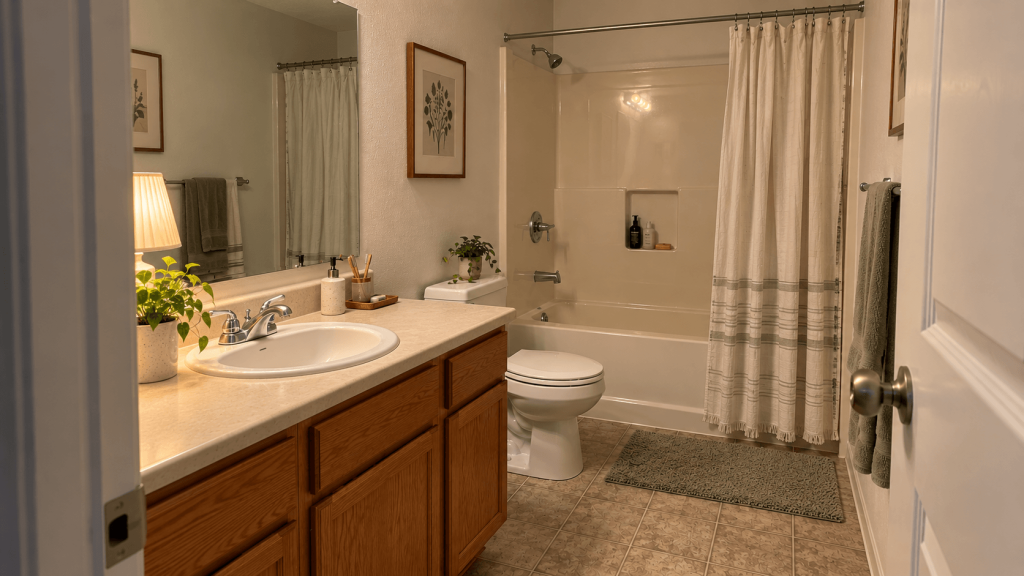
The point isn’t that shower curtains and light bulbs are universally good renter upgrades. It’s that in the right bathroom, one of them may change enough of the room that the harder project you were planning no longer feels necessary.
Floors, wall tile, vanities, countertops, and shower surrounds are different.
They can have enormous visual impact, which is exactly why they’re tempting targets. But they also come with more effort and, in a bathroom, more constraints around moisture, grout, caulk, textured surfaces, seams, and removal.
The harder a bathroom surface is to change safely, the more certain you should be that it’s actually the problem before you touch it.
So if you’re thinking about covering the floor, try a thought experiment first:
If the floor really does turn out to be the thing you can’t stop noticing, use the same logic before deciding how much of an ugly rental floor is actually worth covering.
Imagine the same vanity, the same mirror, the same wall tile and the same light—but with a floor you liked.
Would you walk in and think, Yes, this basically fixes it?
Or would your attention immediately move to the vanity?
If it’s the second one, the floor may not have as much leverage as it seemed.
That’s also why changing small accessories just because they’re easy can be misleading. A new soap dispenser or basket may be nice to have, but it probably won’t change how you feel about a bathroom dominated by a dark vanity or a floor you can’t stop noticing.
Make one change that has a realistic chance of affecting the room.
Then look again.
Maybe you change the harsh light or replace the shower curtain and discover that the floor you were ready to cover now feels merely dated.
Not your favorite. Not what you would install in your own house.
But fine.
That difference matters.
If the Fixed Feature Still Bothers You, Decide How Far to Go
Sometimes the easier changes don’t solve it.
You remove the competing colors, improve the light, simplify the room—and you still walk in and immediately see the same floor, vanity, or tile.
Now you have a much better reason to consider doing something about it.
That still doesn’t mean you have to cover or replace it.
First see whether the room can work with the feature instead. A dated color may become easier to live with if the rest of the room stops fighting it. A vanity you wouldn’t choose may need less attention once the countertop is clear and the lighting is better.
If working around it still doesn’t get you there, then a temporary change may be worth considering.
At that point, the practical questions matter: whether the surface is suitable, what your lease allows, how it will handle bathroom conditions, how difficult removal may be, and whether the payoff is worth the effort.
A product being described as removable doesn’t automatically make it appropriate for every bathroom surface.
But now, at least, you know why you’re considering the project.
You’re no longer putting temporary flooring over the bathroom floor because rental bathroom makeover search results told you that you could.
You’re considering it because you’ve tried the easier possibilities and the floor is still the thing keeping you from liking the room.
That’s a much better reason to take on the work.
And if the thing you’re trying to work around is damaged, plumbing-related, electrical, or reasonably belongs with the property itself, ask before designing an elaborate workaround around a problem the landlord may be responsible for.
Stop When the Bathroom Stops Feeling Like a Problem
One of the easiest things to do with a rental makeover is keep going.
You start because the bathroom bothers you. Then you change the light, so the shower curtain suddenly looks wrong. You replace that, which makes you think about the rug. Then the hardware starts looking dated next to everything new.
There is always another thing you could improve.
That doesn’t mean you should.
Maybe all you changed was the lighting and shower curtain.
The floor is still dated. The vanity is still landlord-grade. The mirror is still the same builder-basic mirror that was there when you moved in.
But now you walk into the bathroom and none of those things feels urgent anymore.
That may be enough.
You don’t have to finish the makeover you imagined before you started.
If the first one or two changes removed most of what was bothering you, the remaining projects don’t become worthwhile just because they were once on your list.
This is especially important in a rental, where every project competes with something else for your money, your time, and eventually your effort when you move out.
The goal isn’t to turn a rental bathroom into the bathroom you would have chosen.
FAQs
How can I make a rental bathroom look better without renovating?
Start by identifying the feature that has the most visual impact. Before covering tile or flooring, try changing easier variables such as the shower curtain, lighting, bath mat, or countertop clutter and see whether the fixed finish still dominates the room.
What are the easiest renter-friendly bathroom upgrades?
Movable items such as shower curtains, bath mats, storage, and decor are usually the easiest to reverse. Some fixture or hardware swaps can also be reversible, but check your lease and keep the original parts.
Can you use peel-and-stick tile in a rental bathroom?
Possibly, but being removable does not automatically make a product suitable for every floor or wall. Bathroom moisture, grout lines, surface condition, installation, removal, and your lease all matter.
How do you deal with ugly bathroom tile in a rental?
First decide whether the tile itself is the problem or whether surrounding colors, lighting, and other finishes are making it feel louder. If the tile is staying, you may get more value from changing what surrounds it than from covering it.
How much of a rental bathroom should you change?
Only as much as it takes for the room to stop feeling like a problem. If one or two reversible changes remove most of what was bothering you, the rest of the makeover does not automatically become worth doing.