How to Hang Curtains Over Vertical Blinds in a Rental
Keep the vertical blinds and add curtains without creating a new problem. Measure clearance first, then choose a mounting method that lets both layers keep working.
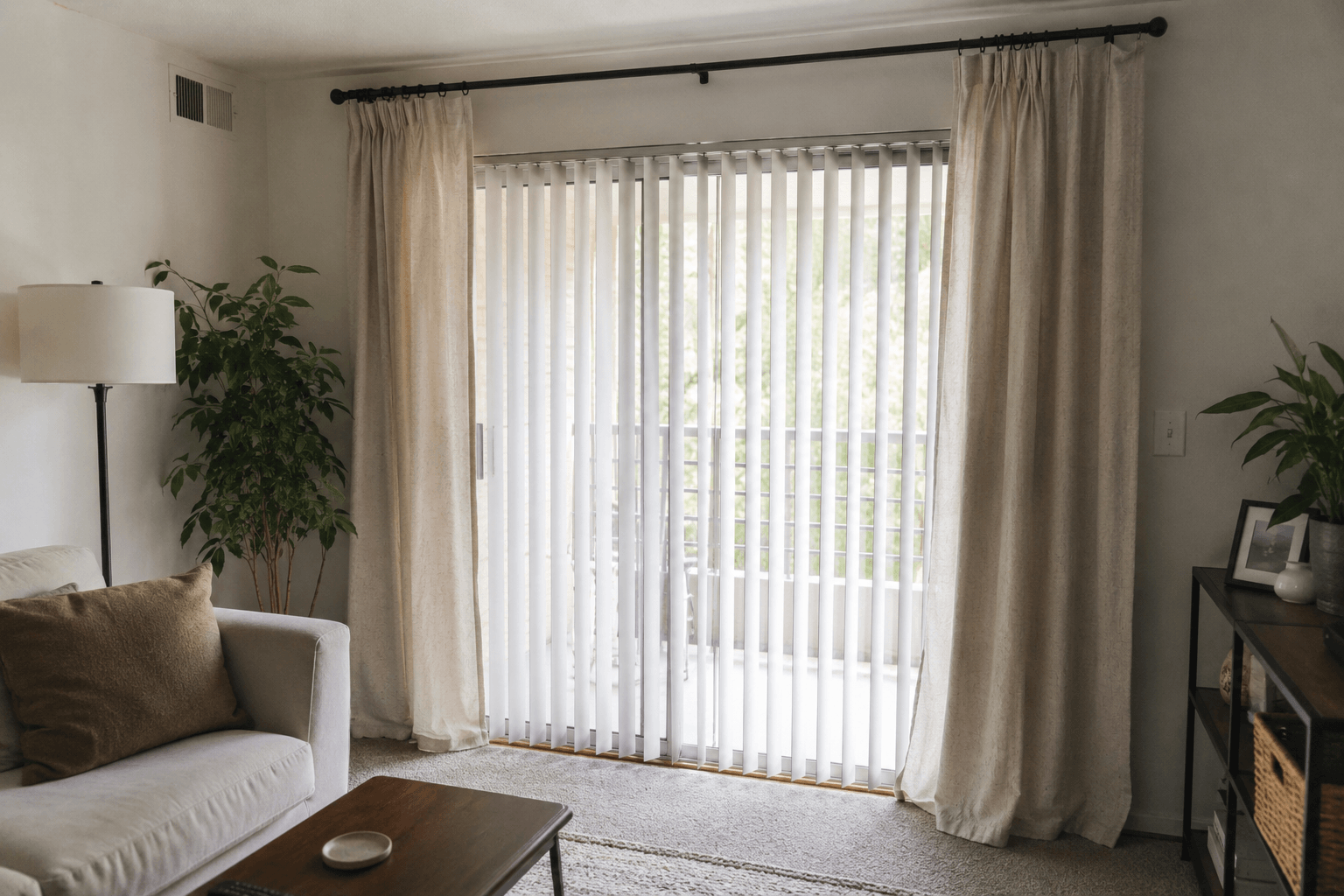
Yes, you can usually hang curtains in front of vertical blinds without removing them. The question is whether your window has a safe place for the curtain rod—and enough room for the curtains and blinds to work together.
The most common mistake is measuring only the window opening. A vertical blind system extends into the room, and the vanes need extra space as they rotate. A curtain rod can be securely mounted and still end up too close to the blinds.
Before choosing hardware, look at three things: how far the blinds project from the wall, what mounting surfaces or headrails are available, and where both layers will go when open.
Those checks will help you rule out options that won’t work before you buy them.
If your window has horizontal rather than vertical blinds, start with whether to remove horizontal blinds or keep them behind the curtains.
Quick Take
If you are still deciding whether the blinds are worth covering at all, start with Ugly Vertical Blinds in a Rental? 5 Ways to Deal With Them before choosing hardware.
Before You Buy Anything, Measure These 5 Things
You need to measure the space the curtain will actually occupy, not just the width of the glass.
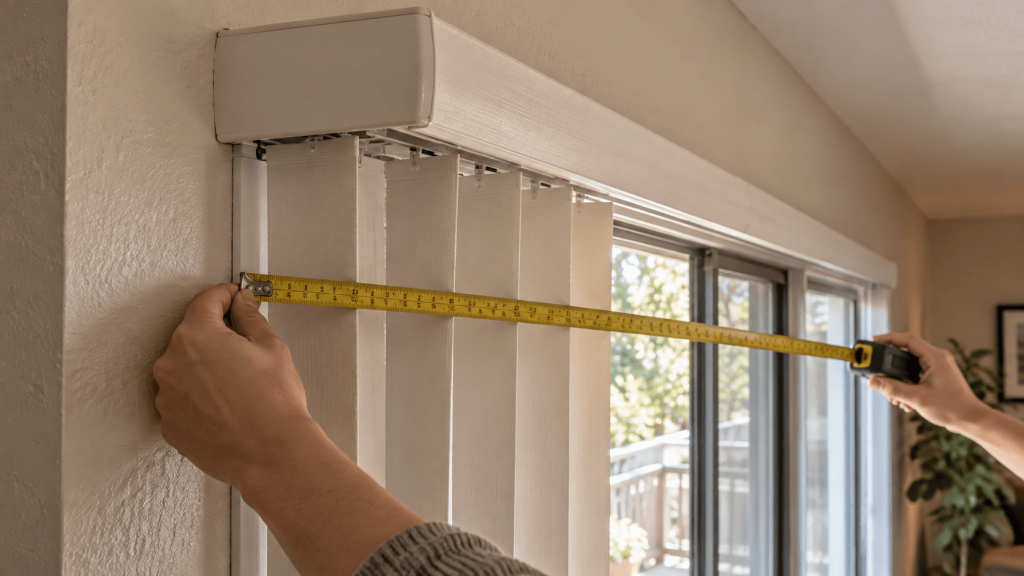
A side-angle photo is useful here. Stand at one end of the blind system so you can see the headrail, vanes, wall, and any projecting trim in the same view.
1. Find the farthest point of the blind system
Measure from the wall or relevant mounting reference to the farthest part of the existing blinds.
Check more than the headrail. A valance may project farther than the metal track, and the vertical vanes change position when they rotate.
Turn the vanes through their normal range while checking the distance. The important measurement is the maximum space the blinds occupy during use.
For example, suppose the vanes reach 4½ inches into the room at their farthest point.
That means a curtain hanging within that 4½-inch space is likely to interfere with them. It does not mean every renter needs a bracket that projects exactly 4½ inches. You still need room for the curtain fabric and its movement.
2. Identify a real place for the rod to attach
Look above and beside the blinds before choosing a mounting method.
You may have:
- Wall space above or outside the window opening.
- An existing vertical-blind headrail that accepts a compatible curtain bracket.
- A recess with two suitable opposing surfaces for a tension rod.
- A smooth wall or trim surface that meets the requirements of purpose-made adhesive curtain hardware.
These are different mounting conditions. A product that works beautifully on one window may have nowhere suitable to attach on another.
If the only available surface is damaged, unstable, or excluded by the hardware manufacturer, cross that method off your list.
3. Measure the actual curtain-rod span
Decide where the curtain will begin and end when closed—and where the panels will sit when open.
If you want to hide the vertical blinds, the rod may need to extend beyond the blind headrail. But extra width also creates a longer span for the rod and its supports.
Check the product’s supported rod length, diameter, bracket spacing, and load requirements. On a wide sliding door, do not assume that two brackets are sufficient simply because the brackets fit the headrail.
A long rod may need additional support, but that support also has to fit without interfering with the blind carriers or curtain movement.
4. Check where the blinds and curtains will stack
Open the vertical blinds completely. Do they stack on the left, right, or both sides?
Now imagine the curtain panels pulled fully open. They need their own space beside the glass, and that space may overlap with the blind stack.
This becomes especially important on a sliding glass door.
If the active door panel, vertical-blind stack, and curtain stack all compete for the same narrow area, you may have a layout problem that a different bracket cannot solve.
5. Account for the complete hanging load
Curtain hardware supports more than the fabric.
Include the rod, panels, rings or clips, and any other accessories. Consider how frequently you will pull the curtains and whether the panels are lightweight decorative fabric or heavier blackout material.
The same mounting point may be reasonable for a light curtain that stays mostly open but unsuitable for heavy panels pulled across a wide door twice a day.
Use the manufacturer’s limits for the complete setup rather than assuming every no-drill product is suitable for every curtain.
Turn those measurements into a real clearance check
Once you know the maximum blind projection, compare it with where the finished curtain will hang.
If your vanes reach 4½ inches from the wall, a bracket described as having a 5-inch projection does not automatically solve the problem. That specification may describe the rod position rather than the nearest surface of the curtain folds.
Depending on the curtain header, the fabric may hang behind the rod centerline. Rings, pleats, and folds can also move as the curtain opens.
Check the space between the moving blind vanes and the nearest part of the hanging curtain, not just the distance between the wall and the rod.
A practical way to visualize the problem before buying hardware is to hold a straightedge or sample rod where the proposed rod would sit. Then hold a folded section of curtain fabric beneath it and rotate the vanes.
You are not testing the strength of the eventual installation. You are checking whether the two layers can physically occupy those positions.
If they touch, you need a different mounting position or a different solution—not just a stronger bracket.
Option 1: Wall-Mount the Curtain Rod in Front of the Blinds
Wall mounting is worth considering when your lease allows it and there is suitable wall space above or beside the existing blind system.
It gives you more freedom to choose the rod’s height, width, and distance from the blinds. That flexibility can be useful for wide windows and sliding doors, especially when a no-drill bracket cannot position the fabric far enough forward.
Check projection before you drill
Use the blind projection you measured earlier, then compare it with the published dimensions of the brackets.
Look for the actual rod position and consider how the curtain will hang from it. A bracket with a deep-looking arm in a product photo may not provide enough usable clearance once the fabric is added.
If possible, mark the proposed rod position temporarily with painter’s tape before installation. Stand back, check the height, and make sure the position leaves room for the blind vanes and the curtain stack.
Before installing, confirm the mounting surface, suitable anchors or fasteners, hardware support requirements, and permission under your rental rules.
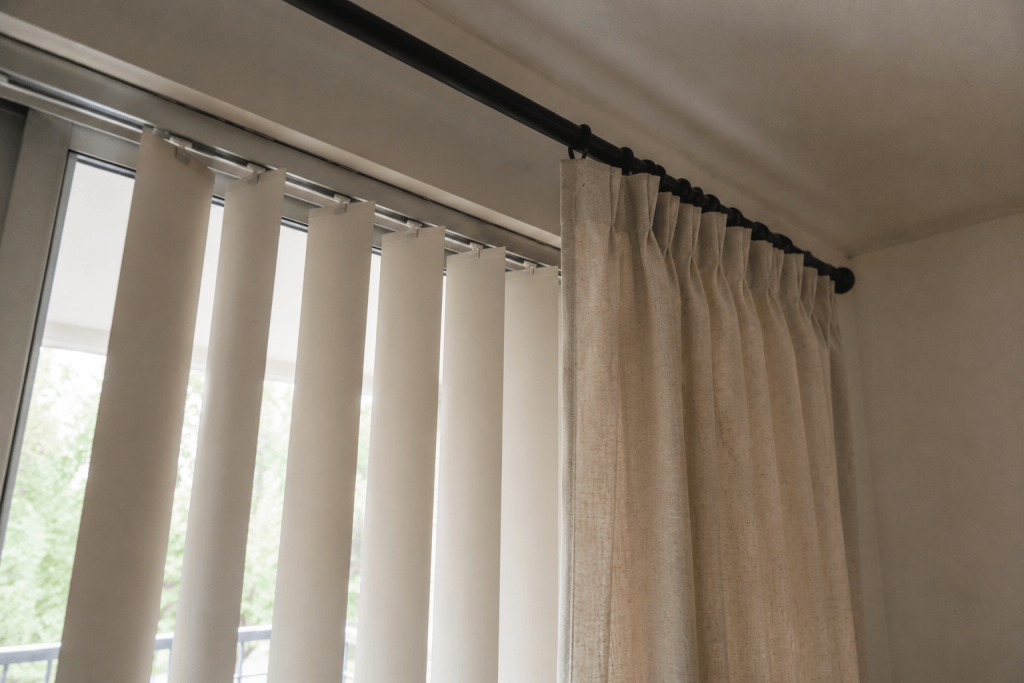
A secure bracket can still be in the wrong place
Sometimes the available wall is too narrow, the trim pushes the brackets into an awkward position, or a deep bracket makes the curtain extend farther into the room than you want.
Those are reasons to change the plan before drilling.
If a conventional rod is permitted and fits the window properly, it may ultimately be simpler than buying several specialized no-drill products that still don’t provide good clearance.
Option 2: Use a Bracket That Attaches to the Vertical Blind Headrail
If you cannot drill, a bracket designed for an existing vertical-blind headrail may be the most direct option to investigate.
This is different from hanging curtain panels from the carriers that hold the vertical vanes.
A headrail-mounted curtain bracket attaches to the blind’s structural headrail and supports a separate curtain rod in front of it. Whether this works depends on the exact shape and size of the headrail, how the blinds are mounted, and the condition of the existing installation.
If you cannot drill, a bracket designed for an existing vertical-blind headrail may be the most direct option to investigate.
This is different from hanging curtain panels from the carriers that hold the vertical vanes.
A headrail-mounted curtain bracket attaches to the blind’s structural headrail and supports a separate curtain rod in front of it. Whether this works depends on the exact shape and size of the headrail, how the blinds are mounted, and the condition of the existing installation.
Identify the blind mount before shopping
Start by checking whether the vertical blinds are inside-mounted or outside-mounted.
An inside-mounted headrail sits within the window or door opening. An outside-mounted headrail is installed over or around the opening.
Those two configurations may need different brackets.
For example, NoNo Bracket publishes the following specifications for its standard vertical-blind models:
| MODEL | LISTED HEADRAIL FIT | CURTAIN ROD |
|---|---|---|
| Standard inside-mount NoNo Bracket | 1.25-inch inside-mounted headrail | 1-inch rod |
| Outside-mount NoNo Bracket | Adjustable 1.5–2-inch outside-mounted headrail range | 1-inch rod |
Sources: NoNo inside-mount specifications and NoNo outside-mount specifications.
These specifications are examples of how model-specific the fit can be—not a recommendation to buy either bracket without measuring.
If your blinds have a decorative valance, distinguish it from the structural headrail. NoNo’s official instructions tell customers to remove the valance when necessary to measure the actual headrail and identify the correct bracket style.
Do not assume that a bracket advertised for blinds will fit a different headrail profile, even if the stated width looks similar.
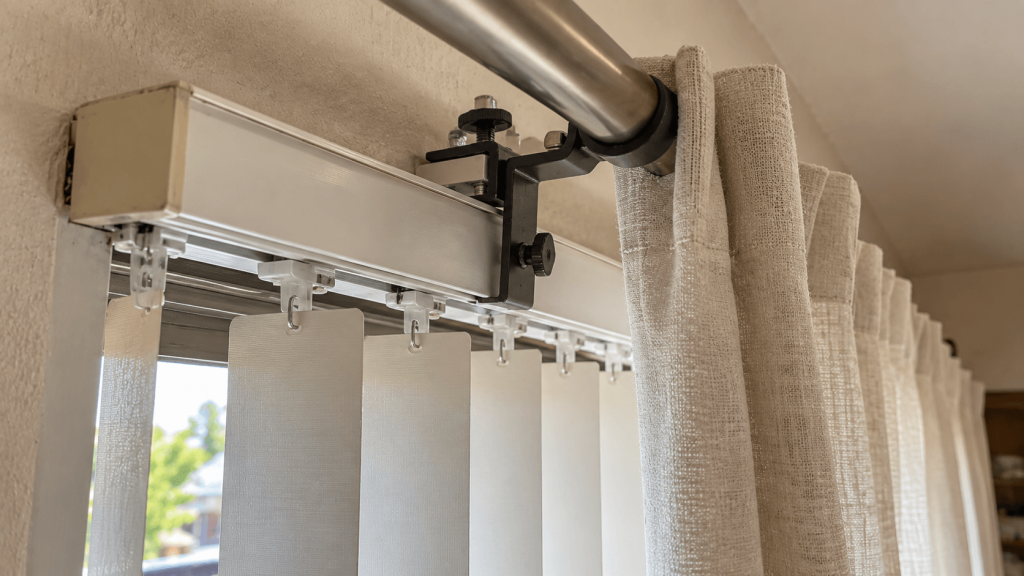
Check the headrail before adding more weight
A headrail-mounted curtain bracket transfers the additional load through the existing blind installation.
That means you need to check both the new bracket and the old hardware supporting the blinds.
Operate the blinds and look for movement at the headrail, loose mounting points, cracked parts, or existing damage. If the headrail shifts or feels unstable, don’t add curtains to it.
The manufacturer also advises against installation on a loose or damaged headrail.
Check the instructions for bracket quantity and placement, especially on a wide opening. Don’t improvise an attachment to the vane carriers or clamp hardware onto a decorative cover that isn’t designed to carry the curtain.
Best fit: A secure, compatible vertical-blind headrail, suitable curtain weight, and no permission to drill new mounting holes.
Poor fit: An unusual or damaged headrail, a rod that doesn’t match the bracket, or a setup that places too much load on the landlord’s existing blinds.
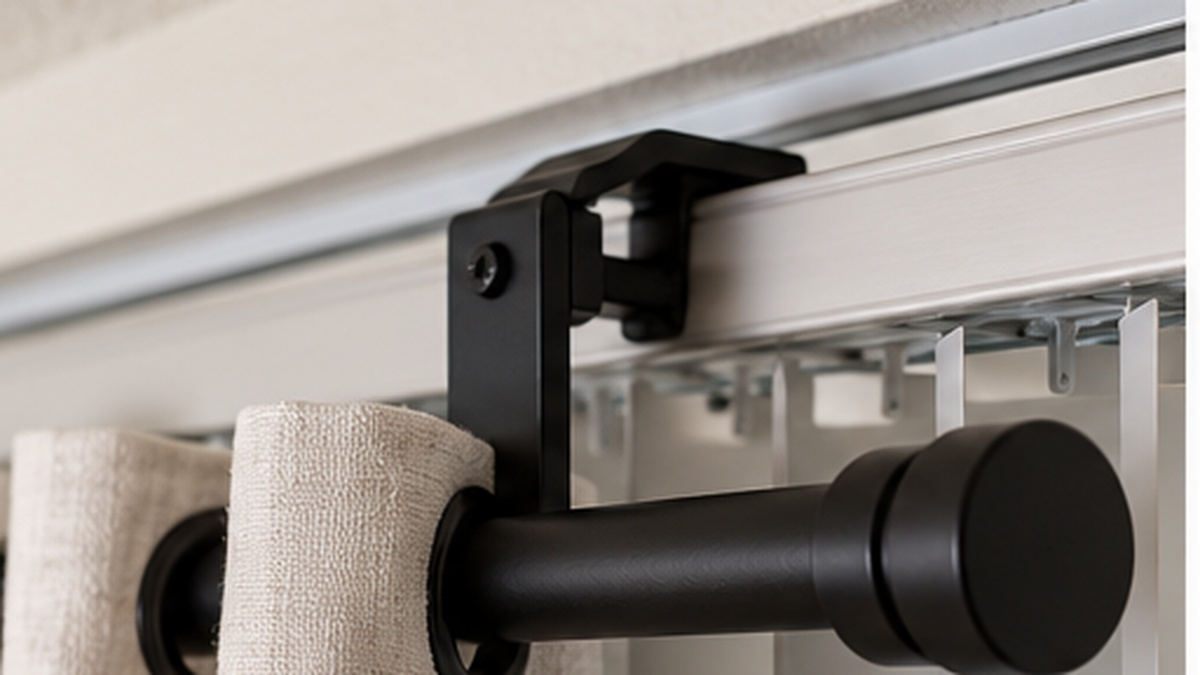
IF YOUR HEADRAIL IS COMPATIBLE
No-Drill Brackets for Curtains Over Vertical Blinds
This is the type of hardware this mounting method is built around: a separate bracket attaches to the existing blind headrail, then supports its own curtain rod in front of the blinds.
Good fit: You cannot drill, the existing blind headrail is secure, and its mount and dimensions match the bracket you choose.
Check first: Inside- and outside-mounted blinds may require different hardware. Measure the structural headrail rather than relying on the valance.
This section contains affiliate links. If you buy through them, we may earn a commission at no extra cost to you.
Option 3: Use a Tension Rod Only If the Opening Supports It
Tension rods are often suggested as the easiest renter-friendly curtain solution, but vertical blinds can make their placement difficult.
A tension rod needs two suitable opposing surfaces. It also needs to sit in a position where the hanging curtain clears the blind system.
Those are two separate requirements.
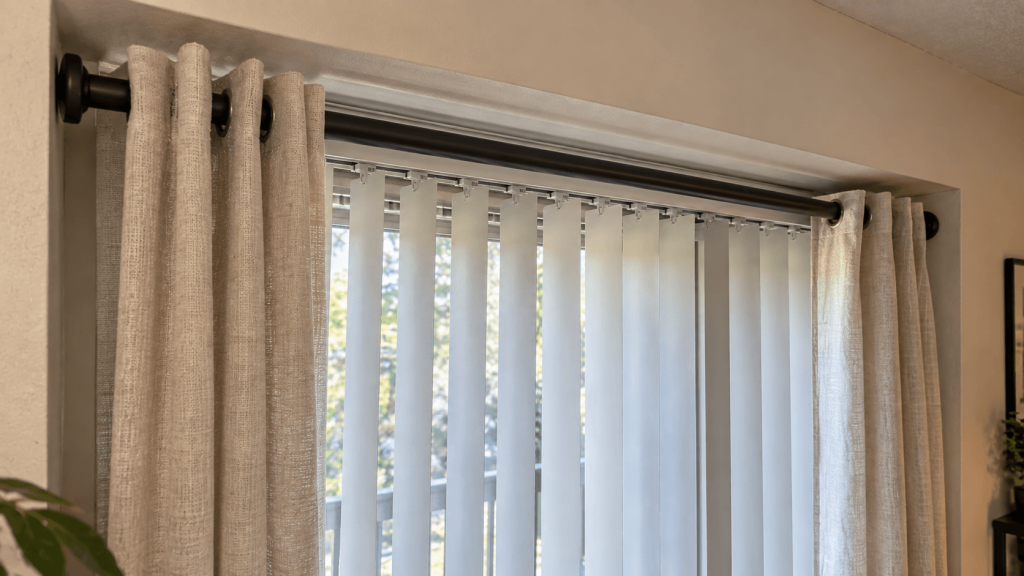
Check the recess before buying
Look at the space in front of the existing blind headrail.
Can a tension rod sit securely between two opposing surfaces there? Or does the blind system already occupy most of the recess?
A rod that fits perfectly across the window opening may still place the curtain directly against the rotating vanes.
Check the rod’s approved width range and supported load, then compare the proposed rod position with the maximum blind projection. Avoid assuming that increasing the rod’s tension will make an unsuitable location acceptable.
Also consider whether the contact surfaces could be marked or compressed by the rod’s end caps.
Best fit: A sufficiently recessed opening with suitable opposing surfaces in front of the blinds and a curtain setup within the rod’s specifications.
Poor fit: A shallow opening, no usable opposing surfaces, or a rod position that puts fabric into the blind vanes.
If your opening doesn’t provide that geometry, a tension rod is not the shortcut it first appears to be.
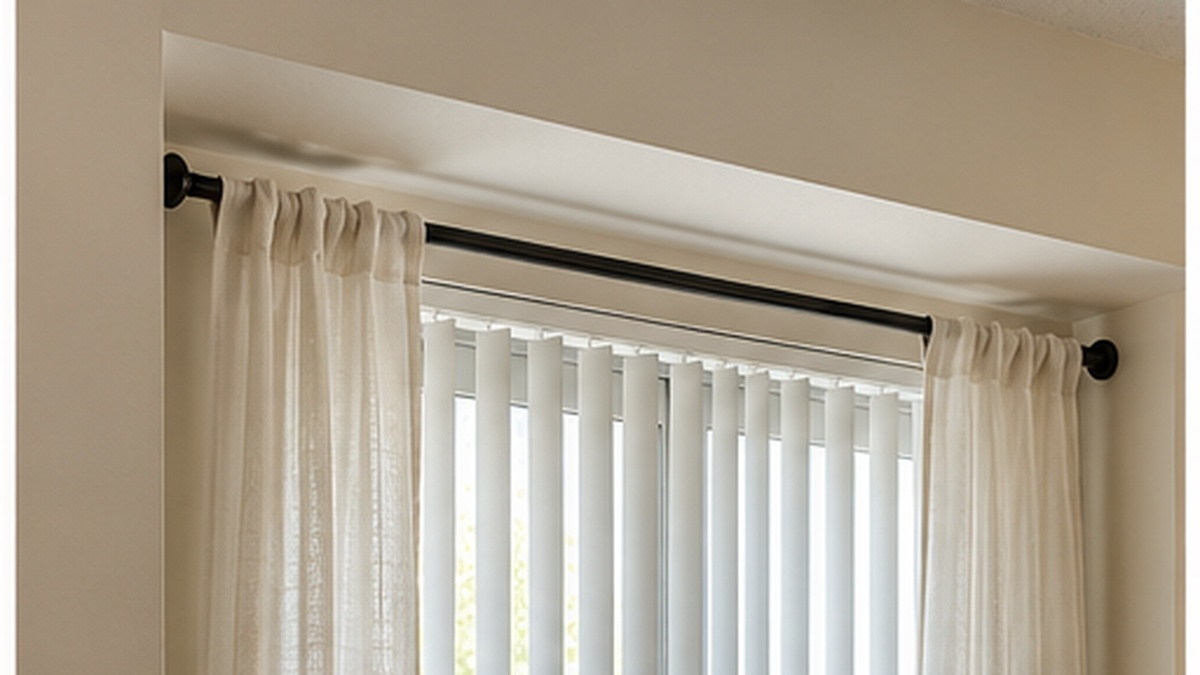
IF THE RECESS ACTUALLY WORKS
Tension Rods for a Recessed Opening
A tension rod makes sense here only after you confirm that two opposing surfaces exist far enough forward to keep the curtain clear of the vertical blinds.
Good fit: A recessed opening where the rod can sit securely in front of the blind system instead of behind it.
Check first: Measure the opening width and the curtain clearance separately. A rod can fit the opening perfectly and still sit in the wrong plane.
This section contains affiliate links. If you buy through them, we may earn a commission at no extra cost to you.
Option 4: Use Adhesive Hardware Only Within Its Actual Limits
Adhesive curtain hooks can be useful when the wall surface, rod, and curtains all match the requirements of a specific product.
The problem is that “adhesive curtain hook” describes a category, not a standard weight capacity or installation method.
Before buying, find the exact product instructions.
For example, the 3M Command Decorative Curtain Rod Hook, product 17654, is advertised for loads up to 10 lb and rod diameters of 0.5–0.75 inches.
Its listed suitable surfaces include smooth painted walls, finished wood, tile, metal, laminate, and glass. It is not intended for wallpaper, fabric, textured walls, brick, or rough surfaces.
See the official 3M Command Curtain Rod Hook specifications.
Those limits belong to that particular product. Another adhesive hook—even one from the same brand—may have different requirements.
Check more than the stated weight limit
The manufacturer’s stated weight capacity does not mean every rod-and-curtain arrangement below that weight will work.
Also check the rod diameter, supported span, wall condition, installation preparation, and expected use.
Consider the direction and frequency of the forces on the hardware. Curtains pulled across a wide sliding door can put repeated stress on the mounting points.
Follow the specified installation and removal procedures, including any curing or waiting periods. A smooth-looking rental wall is not necessarily in good enough condition for adhesive mounting.
Best fit: A lightweight setup on an approved surface, using purpose-made curtain hardware within the manufacturer’s stated limits.
Poor fit: Textured paint, unknown wall condition, heavy curtains, unsupported rod dimensions, or repeated pulling beyond what the hardware is designed to handle.
If the only way to support your curtains is to use adhesive hardware outside its instructions, that is a reason to reconsider the installation.
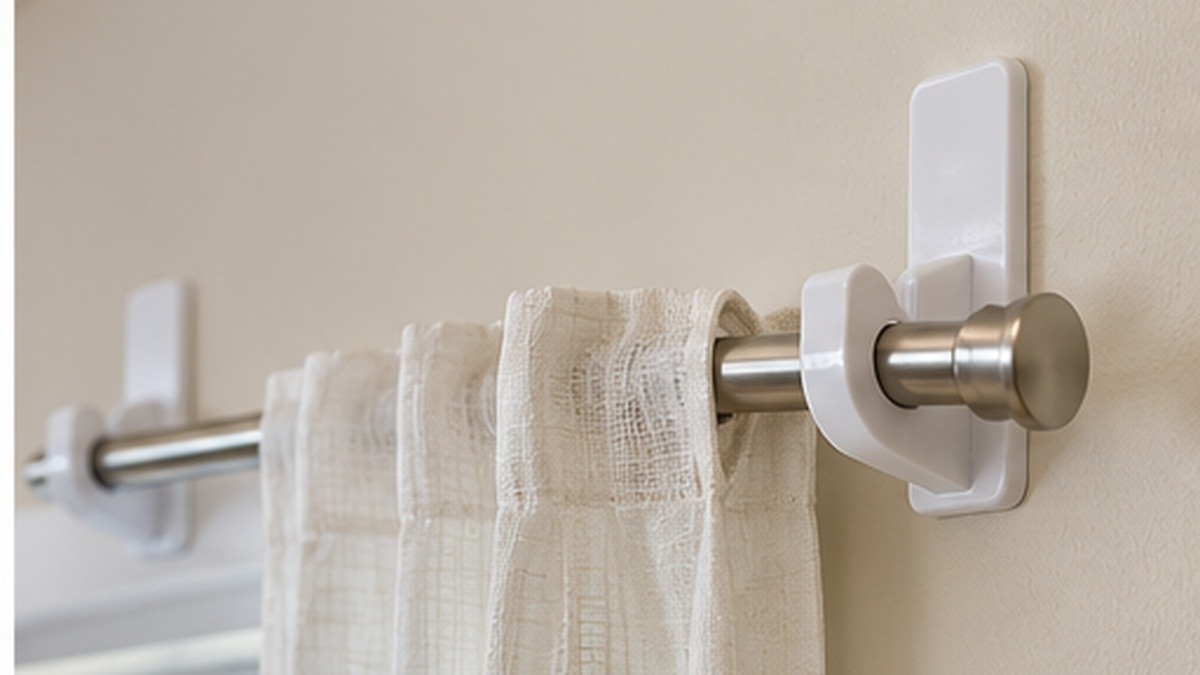
FOR A LIGHT, SPEC-CHECKED SETUP
Adhesive Curtain Rod Hooks for Light Curtains
Purpose-made curtain rod hooks are a better starting point than improvising with ordinary adhesive hooks, but the exact product limits still matter.
Good fit: A light curtain setup on a supported smooth surface, with the rod and total hanging load staying inside the product’s stated limits.
What to watch: Rod diameter, span, wall surface, curtain weight, and repeated pulling can all turn an otherwise suitable adhesive setup into the wrong choice.
This section contains affiliate links. If you buy through them, we may earn a commission at no extra cost to you.
If the Vertical Blinds Cover a Sliding Glass Door, Test the Traffic Path Too
Sliding doors are a little different from ordinary windows because people need to walk through them.
A curtain installation can look excellent when everything is closed and still become frustrating when you want to go outside.
Before choosing the final rod position, check what happens when both window treatments are open.
Rotate the vanes
Turn the vertical vanes fully in both directions.
Watch the front edge of the vanes and see whether it touches the proposed curtain position. Do this with the curtains hanging naturally, not held flat against the rod.
If the fabric moves whenever the vanes turn, the layers are too close.
Stack the blinds
Open the vertical blinds completely and note how much space they occupy at the side.
Now pull the curtain panels to their intended open positions.
If the curtain stack sits directly in front of the blind stack, both layers may still function, but you could lose more of the doorway than expected.
For a wide sliding door, the open position deserves as much attention as the closed position.
Walk through the open door
Open the curtains, open the active door panel, and walk through normally.
Can you carry laundry, a plant, or something bulky through without brushing past hanging fabric or pushing a curtain aside?
Does the curtain catch on the door handle or interfere with the sliding panel?
If using the door requires rearranging fabric every time, the window treatment may not be worth the inconvenience.
This is also why a lightweight curtain and a heavy blackout curtain can lead to different installation decisions for the same sliding door.

The Curtain You Choose Can Change Which Mount Works
You don’t have to choose a specific curtain fabric before finding the mounting location, but you should know what job the curtain needs to do.
| CURTAIN SETUP | WHAT CHANGES |
|---|---|
| Lightweight decorative panels | Lower hardware demand; easier to leave mostly stationary |
| Everyday privacy curtains | Repeated movement becomes important |
| Heavy blackout curtains | Load, projection, span, and movement all become more demanding |
| Wide sliding-door panels | Stack-back space becomes part of the installation |
A curtain that mainly softens an ugly blind system may need much less hardware than a full-width blackout setup used every night.
If the real problem is light leaking around closed vertical blinds, see How to Black Out Vertical Blinds Without Removing Them. That guide focuses on coverage and darkness rather than mounting hardware.
And if you’re choosing curtain hardware for ordinary rental windows without vertical blinds, Renter-Friendly Curtains: How to Hang Them in a Rental covers the broader options.
When Not to Force a No-Drill Solution
Sometimes the window doesn’t offer a good no-drill installation for the curtains you want.
That can happen when the headrail has no compatible bracket, the recess is too shallow for a tension rod, the wall surface rules out adhesive hardware, or the only available mounting position interferes with a sliding door.
There isn’t always a different bracket that will fix the problem.
At that point, compare what you’re trying to improve with what the installation would demand.
If drilling is permitted, a properly installed conventional rod may be the simpler long-term choice. If drilling isn’t permitted, you might use the existing blinds and improve the room around them instead of adding another layer.
If privacy—not hiding the blinds—is your main concern, Privacy Window Film vs Curtains in a Rental may be a more useful next decision.
A successful renter workaround should make the room easier to live in, not add something else you have to manage every day.
Do This Movement Test Before You Call It Finished
Once the curtain is installed, test the window treatment as a complete system.
- Rotate the vertical vanes through their full range.
- Stack the blinds completely open.
- Open and close the curtains several times.
- Watch for curtain folds catching, brackets shifting, or the rod sagging.
- If there is a sliding door, open it and walk through normally.
Check the system again after it has been used for a while, especially if the mounting hardware relies on an existing headrail, tension, or adhesive attachment.
If the installation only works when you hold the curtains away from the blinds, shift a panel by hand, or avoid using the door normally, something still needs to change.
FAQ
Can you hang curtains over vertical blinds without taking them down?
Yes, in many rentals. You can leave the vertical blinds in place and install a separate curtain rod in front using suitable wall brackets, compatible headrail-mounted hardware, or another mounting method that fits the opening. The curtains must clear the vanes and allow the blind system to keep working.
Can I attach curtains directly to a vertical blind track?
A compatible headrail-mounted bracket can support a separate curtain rod without removing the blinds. That is different from attaching curtain panels directly to the carriers that hold the vertical vanes. Check the actual headrail dimensions and manufacturer instructions before choosing a bracket.
How can I hang curtains over vertical blinds without drilling?
Start by checking whether the blind headrail accepts a compatible no-drill curtain bracket. A tension rod may also work if the opening has two suitable opposing surfaces in front of the blinds. Purpose-made adhesive hardware is another possibility for certain lighter setups, but only on approved surfaces and within the product’s limits.
How far in front of vertical blinds should curtains hang?
There isn’t one distance that works for every installation. Measure how far the headrail, valance, and rotating vanes reach into the room. Then compare that distance with where the curtain fabric—not just the curtain rod—will hang. Leave enough clearance for both layers to move without touching.
Can you hang curtains over vertical blinds on a sliding glass door?
Yes, but check three things: whether the vanes can rotate, where the blinds and curtains will stack when open, and whether you can still walk through the active doorway comfortably. A curtain that blocks the opening when pulled aside may need a different mounting arrangement.
Can you use a tension rod over vertical blinds?
Only if the opening provides suitable opposing surfaces in the right position. If the rod has to sit behind the front of the blind system, the curtain may interfere with the vanes even when the rod fits securely.
Can Command hooks hold a curtain rod over vertical blinds?
Some Command products are designed specifically for curtain rods, but their suitability depends on the exact model, approved wall surface, rod dimensions, and total load. They are not a universal solution for heavy curtains or textured rental walls.
What if none of the no-drill options fits?
Check whether your lease allows a conventional wall-mounted rod. If it doesn’t, consider whether a lighter curtain, a different window treatment, or leaving the existing blinds in place would solve enough of the original problem without creating new installation risks.
Bottom Line
You can often hang curtains over existing vertical blinds, but the mounting method has to fit the window that’s already there.
Measure how far the blinds project, identify a suitable attachment point, and make sure the fabric can move without interfering with the vanes or sliding door.
If the only available installation ignores the hardware limits or makes the window harder to use, skip it. The point is to improve the rental—not turn a working set of blinds into a new problem.