No Overhead Light in Your Rental? What to Do Before Buying More Lamps
Learn how to light a room with no overhead lighting by fixing placement, coverage, task lighting, and control before buying another lamp.
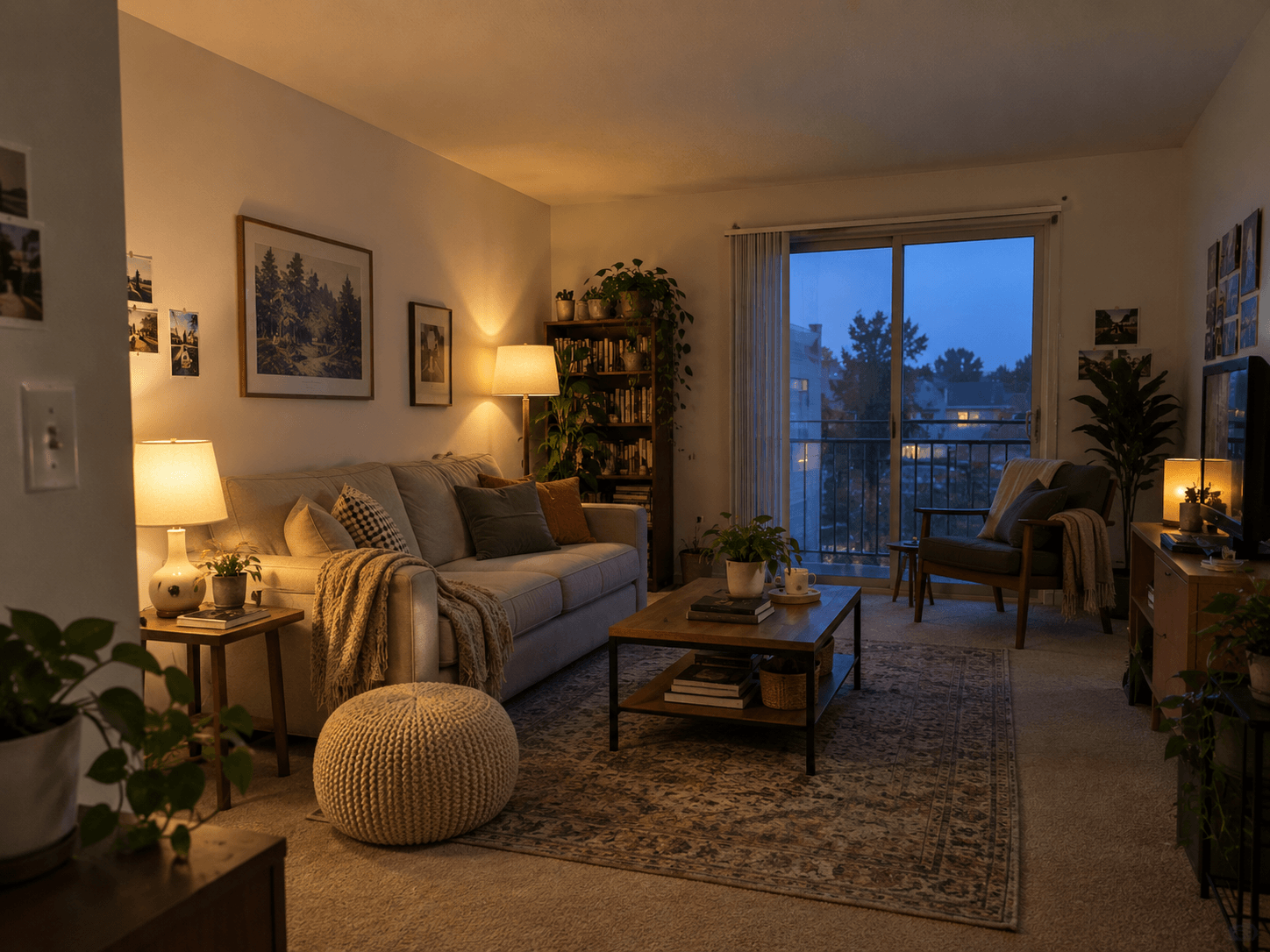
If your rental has no overhead lighting, do not start by buying more lamps. First figure out whether the room needs better overall coverage, light for a specific task, better distribution, or simply easier control.
You may already have enough light sources—they may just be in the wrong places or doing the wrong jobs.
The goal is not to recreate a ceiling fixture with as many lamps as possible. It is to make the room work without one.
If you do have a working ceiling light but avoid using it because you dislike the fixture or the light it produces, start with Ugly Rental Ceiling Light? Is the Fixture Really the Problem? instead.
First, Find Out What That Wall Switch Does
If there’s a wall switch in a room with no ceiling fixture, don’t assume it’s useless. It may control an electrical outlet instead.
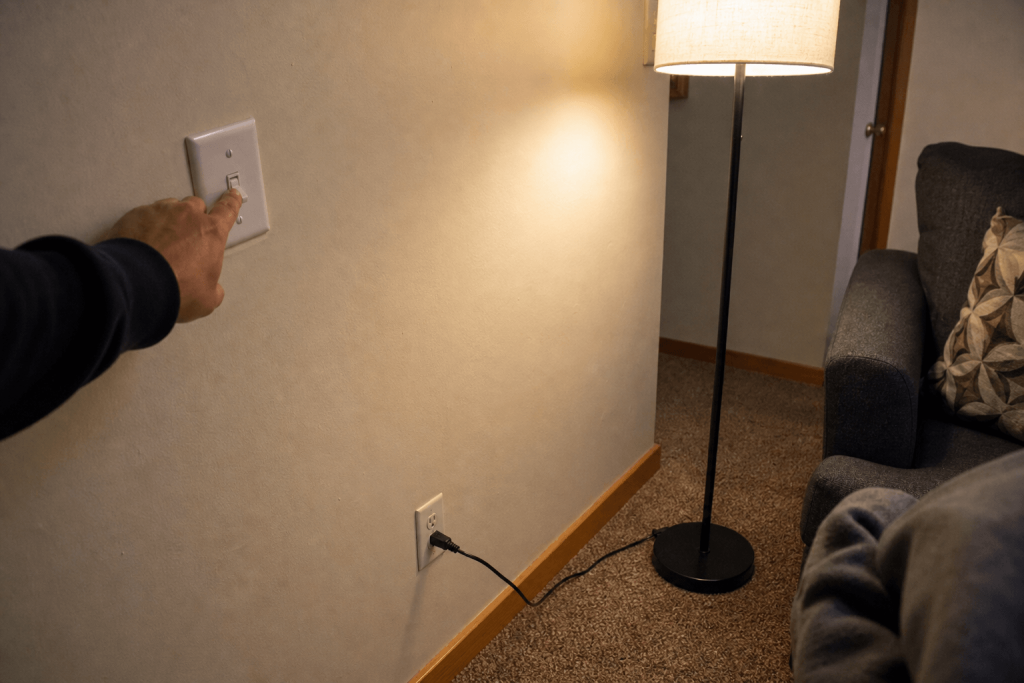
In some rentals, that outlet is how the room gets switch-controlled lighting: plug a lamp into it, leave the lamp itself switched on, and the wall switch can turn it on when you enter.
It only takes a few minutes to check. Turn the wall switch on, plug a lamp into the outlets around the room, and see whether any of them respond when you flip the switch. If an outlet has two receptacles, test both—sometimes only one is controlled by the switch.
If you find one, you’ve found a useful control point. It doesn’t mean your main lamp has to live there forever, but it gives you something to work with.
While you’re checking, look at the rest of the outlets too.
Where could a lamp realistically sit? Where would its cord have to go? Is there an outlet near the desk, sofa, or corner that actually needs light?
A lamp might look perfect beside a chair until you realize the nearest outlet is across a doorway. A floor lamp might solve a dark corner but leave a cord running through a path you use every day.
The outlets are part of the room’s lighting plan, whether you like their locations or not.
It’s better to find those constraints now than after you’ve bought another lamp.
If the apartment feels gloomy even during the day, the problem may be bigger than the missing ceiling fixture. Start with what’s actually making your rental feel dark before trying to fix everything with artificial light.
What Do You Actually Wish the Overhead Light Would Do?
It’s easy to translate no ceiling light into not enough light. Those aren’t always the same problem.
Imagine a ceiling light appeared in the room tomorrow. What would you expect it to fix?
| What bothers you | What may actually be missing |
|---|---|
| The whole room falls flat after sunset | Better overall coverage |
| Reading, working, or hobbies are uncomfortable | Light where the task happens |
| One side of the room disappears | Better distribution |
| The room is bright enough, but turning everything on is annoying | Better control |
A room can feel reasonably bright and still be badly lit for what you do there.
If the sofa area is comfortable but your desk is dim, making the entire room brighter may not help much. You need useful light at the desk.
The reverse can happen too. Several small lamps may make individual spots feel pleasant while leaving the room as a whole strangely dark. Adding another little table lamp could give you more of exactly what you already have.
And if the room feels fine once every lamp is on, brightness may not be the problem at all.
Maybe what bothers you is walking to the floor lamp, reaching behind the sofa for another switch, then crossing the room to turn on the table lamp.
In that case, you may be shopping for more light when what you really want is better control.
A switched outlet may solve part of that. Depending on your setup, remote-controlled plugs, smart plugs, or compatible smart bulbs can also make several separate lamps easier to use together.
Before choosing a solution, make sure you know which problem you’re solving.
Try One Evening With the Lights You Already Have
Before ordering anything, spend one evening experimenting with the lights you already own.
Start with height.
If all your light sources sit around table height, see what happens when you move one higher or use a lamp that sends light upward. A higher source can change the feel of the whole room instead of creating another small pool of light around the furniture.
Then try moving one light across the room.
It’s common for lamps to collect around the places where furniture naturally supports them—a side table, desk, or console. If all of those pieces happen to be on the same side of the room, the lighting ends up there too.
Move one source to the opposite side temporarily and turn everything on again. You may find that the room wasn’t short on lamps; the lamps were just short on distance from each other.
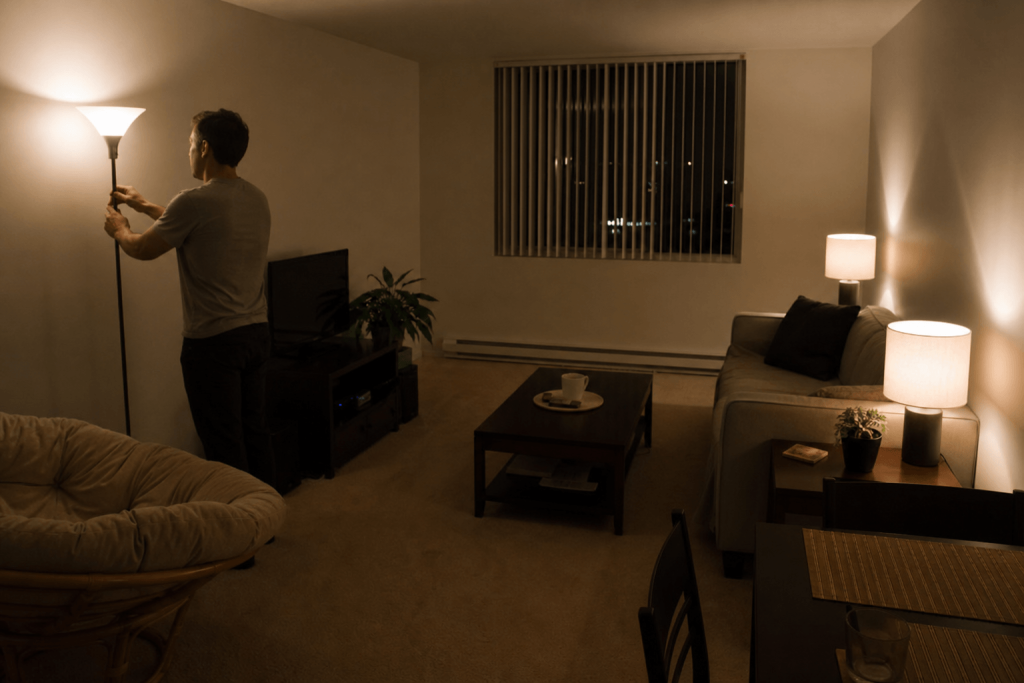
If you have an adjustable lamp, experiment with where the light lands as well. Sending some light toward a light-colored wall or ceiling can spread it more broadly than aiming every source directly at furniture.
You’re not trying to find the final layout in one evening. You’re trying to learn what actually changes the room.
Pay attention to cords while you experiment.
If the position that finally fixes the dark side of the room requires a cord across a doorway, that matters. So does a reading lamp that only works beside your chair if you run an awkward extension cord around the furniture.
That doesn’t mean the experiment failed. It means you found one of the room’s real constraints.
A lighting solution that makes the room harder to live in isn’t much of a solution.
If Something Is Still Missing, Buy for That Job
After moving things around, you may find that the room genuinely is missing a light source.
Now another purchase makes sense—but give it a job first.
| What is still missing? | What to consider |
|---|---|
| More light across the room | A tall floor lamp or uplight that spreads or reflects light |
| Better light at a desk, chair, or table | A task or adjustable lamp close to where you use it |
| Light in one genuinely dead area | A small lamp, floor lamp, or plug-in wall light where the gap actually is |
| Easier control of several existing lights | A switched outlet, remote plug, smart plug, or compatible smart bulbs |
If the whole room needs more light, another low table lamp may not change much. A taller source that spreads light across the room—or bounces it off a wall or ceiling—may be more useful.
If the problem is a desk, reading chair, or dining table, put the light where the activity happens instead of trying to brighten everything around it.
And if one area remains dark even after you’ve redistributed the lamps you already have, adding a light there has a clear purpose.
If the missing light is higher on the wall rather than across the whole room, battery-operated wall sconces are another renter-friendly option—but they make more sense for some lighting jobs than others.
Style still matters. You’re going to live with the lamp every day, and its size, shade, shape, and quality of light all affect how the room feels.
But knowing the job first makes those choices easier.
It also helps you ignore one of the more common assumptions about rooms without overhead lighting: that the goal should always be a soft, cozy glow.
Warm, layered lamp light can be wonderful in a living room where you mostly relax at night. You may even prefer it to a bright ceiling fixture.
But if the room doubles as your home office, craft space, or somewhere you regularly work on detailed tasks, “cozy” may not be enough. And if you simply prefer a brighter room, there’s no reason to design around someone else’s idea of atmospheric lighting.
Choose the lighting for what the room has to do—not for what a lamp-lit room is supposed to look like.
If you already have a hardwired ceiling light but are wondering whether it is worth changing, see Should You Replace a Rental Light Fixture—or Add Another Light Instead?
Know When Lamps Have Become the Workaround
There’s a point where working around a missing ceiling light stops feeling simple.
Maybe you need four or five lamps to get enough coverage. Furniture placement starts revolving around outlets. Floor lamps take up space you don’t really have, and cords become something you’re constantly routing around furniture.
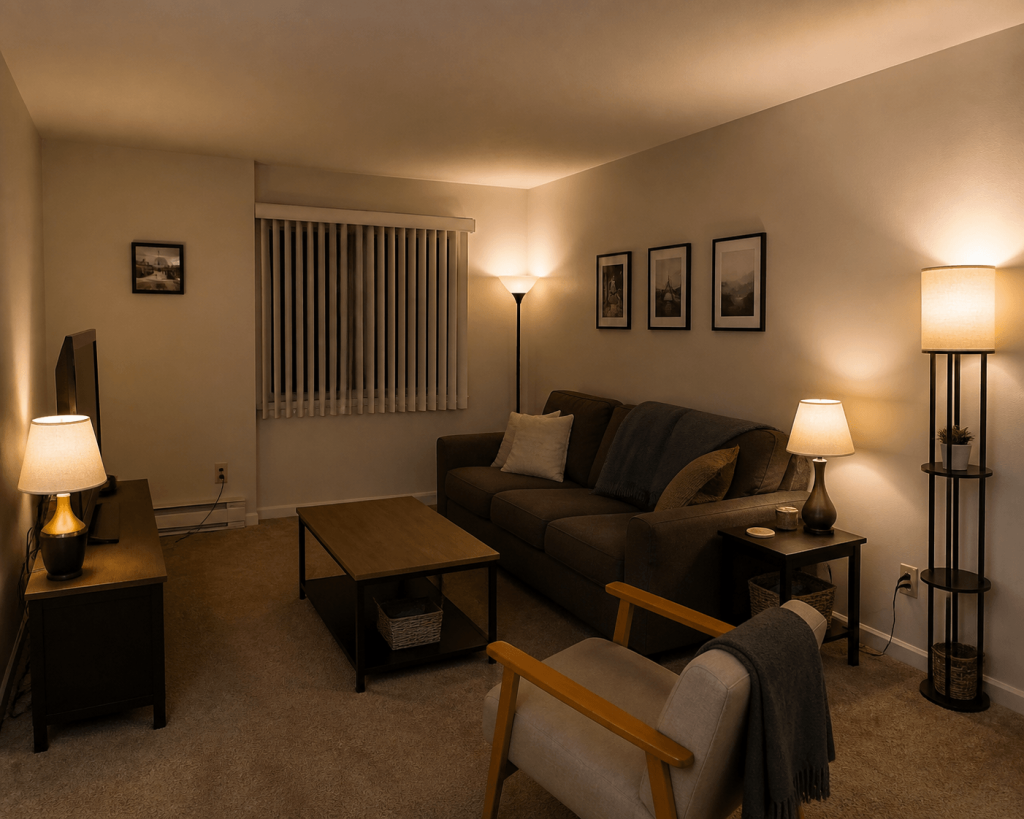
After all of that, you may still wish you could walk into the room and turn on one bright light.
If that’s where you’ve ended up, don’t automatically buy lamp number six.
Ask whether the missing fixture itself has become the problem.
That question is especially worth asking if you expect to stay in the rental for a while and deal with the lighting every day.
If there’s already an electrical box or an obvious fixture location, you can ask the landlord whether installing a ceiling fixture is possible. Anything that requires new wiring or other electrical work belongs with the landlord or a qualified electrician, not on a renter DIY list.
The answer may still be no. But at least you’ll know what constraint you’re actually working around.
At some point, working around the missing fixture can become more complicated than the fixture itself.
If you can answer that last question clearly, you’re probably ready to shop.
If you can’t, don’t buy the lamp yet.
FAQs
How do you light a room with no overhead lighting?
Use more than one type of light instead of trying to make a single lamp replace the ceiling fixture. First decide whether the room needs broader coverage, task lighting, better distribution, or easier control, then place light where that specific job happens.
How many lamps do you need in a room with no ceiling light?
There is no fixed number that works for every room. Start with the lamps you already have and test their height and placement. Add another source only when you can identify a part of the room or a task that still needs light.
What type of floor lamp is best for a room with no overhead light?
If you need broader room lighting, look for a floor lamp that sends light higher or spreads it across a larger area rather than creating another small pool of light beside the furniture. If the problem is a specific reading chair or desk, a more directional task light may be the better choice.
What if the wall switch does nothing?
Test the outlets around the room before assuming the switch is unused. In some rentals, the wall switch controls one outlet—or even one receptacle within an outlet—so a plugged-in lamp can function as the room’s switch-controlled light.
Are wall sconces good for rooms without overhead lighting?
They can be useful when you need light higher on the wall, want to free up floor or table space, or need to fill a specific dark area. Renters can also consider plug-in or battery-powered versions when permanent wiring is not practical.
See Are Battery-Operated Wall Sconces Worth It for Renters?