Is Contact Paper for Cabinets Worth It in a Rental?
Contact paper can transform rental cabinets, but the surface, door shape, workload, and time left on your lease can completely change whether the project is worth doing.
One cabinet door covered in contact paper can look like a five-minute project. A whole rental kitchen rarely is.
The real question is not whether contact paper can change the color of your cabinets. It is whether the existing finish is safe to cover, how much work the doors will take, how much of the kitchen actually needs changing, and whether you will live with the result long enough to make both installation and removal worthwhile.
Before choosing a color or wood grain, figure out how big the project really needs to be.
Quick Take
Start With the Surface, Not the Contact Paper
Before asking which contact paper is easiest to remove, look at what it would be attached to.
A smooth-looking cabinet can still have a weak finish. Paint may already be poorly bonded. Laminate or thermofoil may be lifting at an edge. Older surfaces can have chips, softened areas, or spots that have been repeatedly exposed to grease and moisture.
That matters because removability has two sides.
The contact paper has to release. The cabinet finish underneath also has to stay attached.
Do not assume a product described as removable makes every cabinet surface safe.
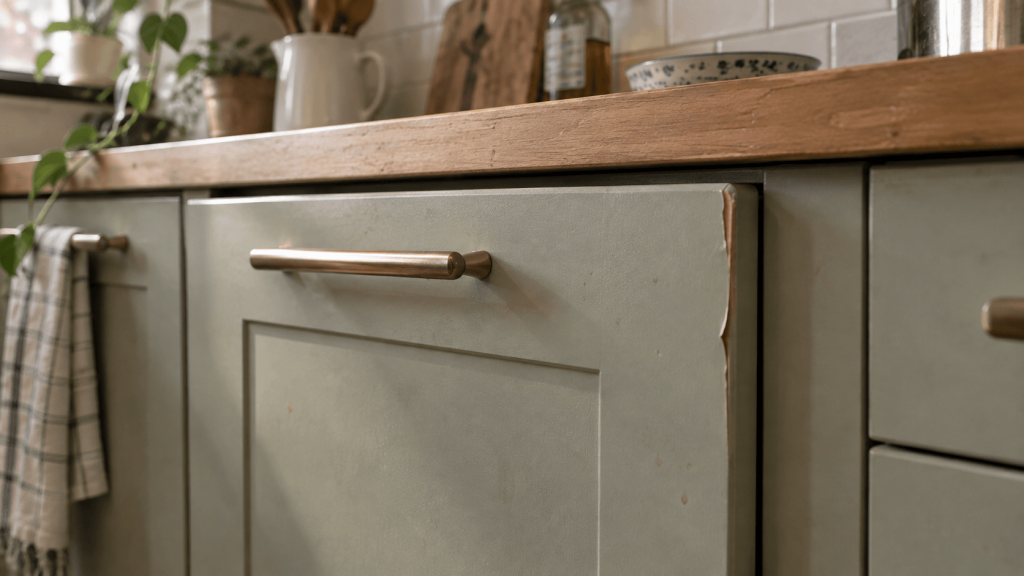
Test a small hidden area first: the inside of a door, a concealed side panel, or another discreet spot with the same finish.
You are not trying to prove that the entire kitchen will be safe forever. You are looking for an obvious reason not to expand the project.
If the original finish begins to lift, soften, peel, or come away during the test, stop there.
If you are not sure whether the cabinet finish itself is really the problem—or whether hardware, lighting, or the surrounding room is making the cabinets feel worse—start with Ugly Rental Kitchen Cabinets? What to Change—and What Not To before covering them.
Flat Doors and Detailed Doors Are Different Projects
A flat slab door gives you one broad surface and relatively few edges.
A Shaker, routed, or raised-panel door gives you more corners, recesses, folds, cuts, and places where the material has to stay neat.
That does not make detailed doors impossible to cover.
It changes the amount of work you are agreeing to.
Eight flat doors can be a contained project. Sixteen detailed doors plus drawers, side panels, and an island can turn the same idea into something much larger.
Before judging the project by one finished sample, look at how many edges and transitions you would actually have to wrap.
Photograph the Kitchen Before You Decide How Much to Cover
Do not start by counting every cabinet in the room.
Take one photo from the place where you see the kitchen most often.
That might be the kitchen entrance. In an open-plan apartment, it might be the sofa or dining table. The useful viewpoint is the one from which the cabinets read as part of the room rather than as individual doors.
Then ask:
Which cabinet surfaces are actually carrying the unwanted color through the room?
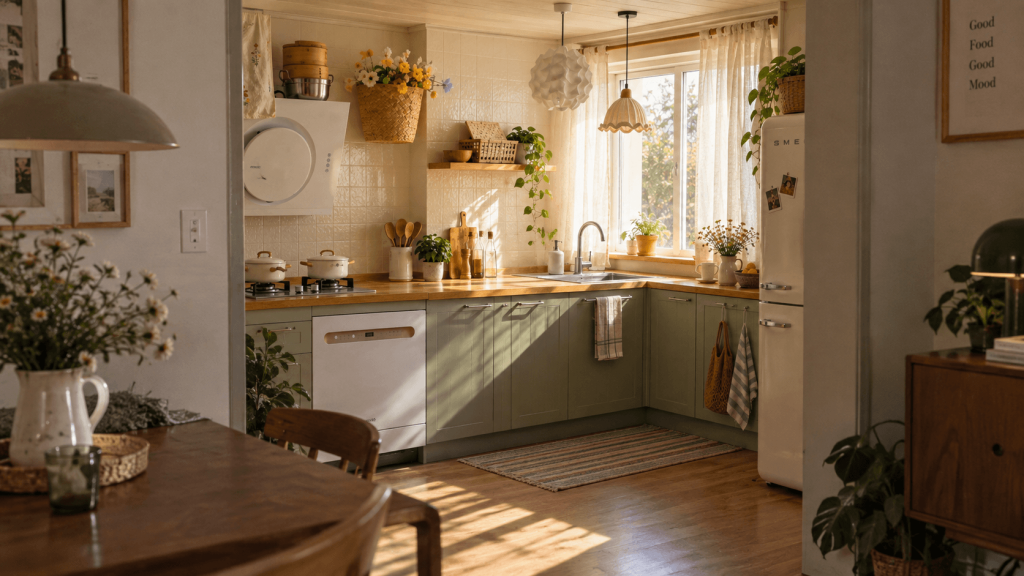
Sometimes the answer really is all of them.
But often it is one visual block.
A dark island may dominate an otherwise light kitchen. Lower cabinets may carry most of the visual weight while the uppers disappear against the wall. From the living room, you may only notice one cabinet run facing outward.
Try changing that one block first—in the photo.
You can roughly cover it with a neutral color on your phone, or simply block it with your hand and look at the rest of the room.
If the kitchen already feels substantially different, you have learned something important:
You may not need to wrap the whole kitchen.
Partial coverage works best when it follows a complete visual zone:
- all lower cabinets
- one full island
- one continuous cabinet run
not three random doors scattered around the room.
Cover the visual problem, not automatically every cabinet door.
Compare the Work With the Time You Will Live With It
Once the surface looks suitable and you know how much you would actually need to cover, the remaining lease starts to matter.
A large kitchen with detailed doors is harder to justify when you expect to move soon. You have to install the material now, live with the possibility of wear or lifting, and remove it all before you leave.
The same work can make more sense when you expect to stay for another two or three years.
There is no useful rule that says contact paper becomes “worth it” after a certain number of months.
A better comparison is:
How much work goes in, how much visual improvement comes out, and how long do you get to live with that improvement?
Also remember that cabinet doors are high-touch surfaces.
Doors near the sink or stove see more wiping, grease, heat, and moisture than a fresh before-and-after photo shows.
You do not need to predict exactly how the material will age. Just ask:
Would this project still feel worth doing if one visible edge started lifting before the rest of the kitchen did?
If one imperfect edge would make the whole makeover feel ruined, full coverage gives you more places for that problem to appear.
Run the Rental Cabinet Contact Paper Check
Before covering a full cabinet run, answer five questions.
Is the surface stable?
If the answer is no—or you are already seeing peeling, loose finish, or damage—stop. This is the one question that can end the project by itself.
Is the door shape manageable?
Eight flat slab doors and eighteen routed doors are not the same project.
Is the visible coverage area reasonable?
If your photo shows that one section is carrying most of the unwanted color, do not assume the whole kitchen needs to match.
Is the remaining lease long enough for the work to feel worthwhile?
Count both ends of the project: installation now and removal later.
Are you comfortable with the removal risk?
“Removable” is not a promise that every original finish will look exactly the same afterward.
If the surface passes the first test but two or more of the other answers still feel uncertain, start smaller or choose another workaround.
Three Kitchens, Three Different Answers
The same contact paper can be a reasonable project in one kitchen and a poor use of effort in another.
8 Flat Slab Doors + Stable Laminate + 2-Year Lease
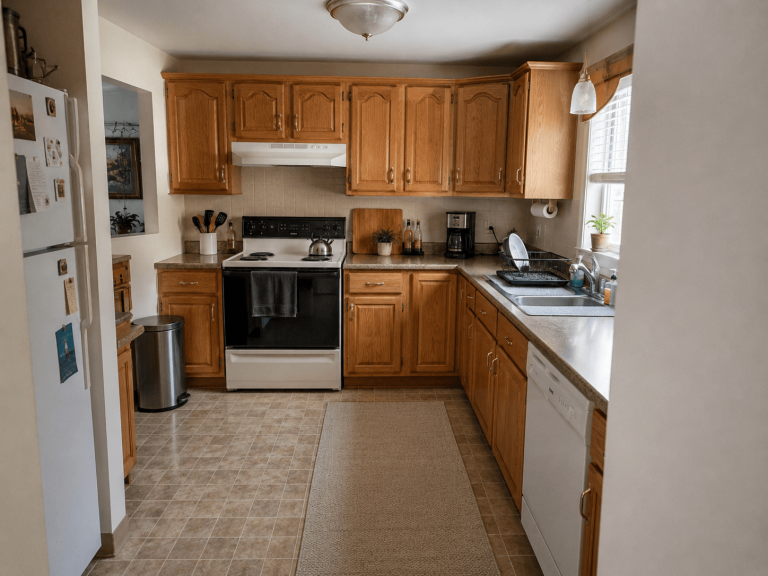
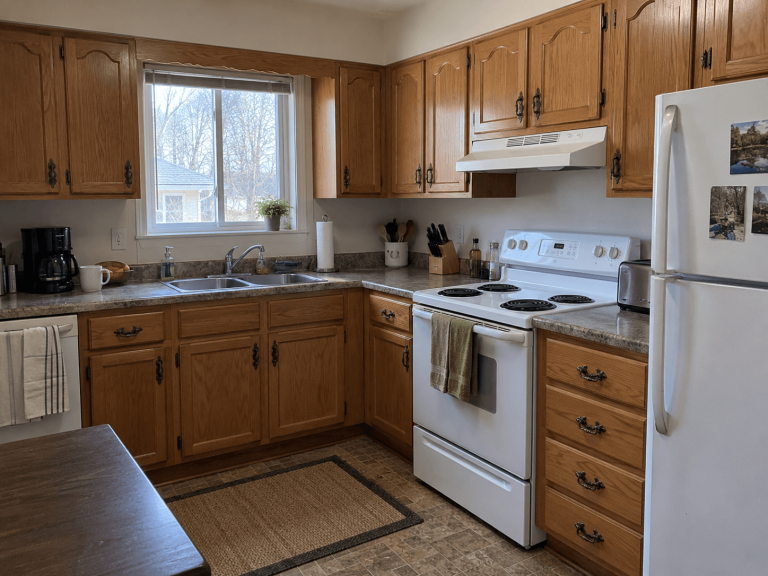
Picture a small rental kitchen with eight simple flat cabinet doors. Their warm brown finish takes up most of the wall you see when you enter the room.
The edges are intact, there are no routed panels to work around, and a hidden-area test does not show an obvious problem with the existing finish.
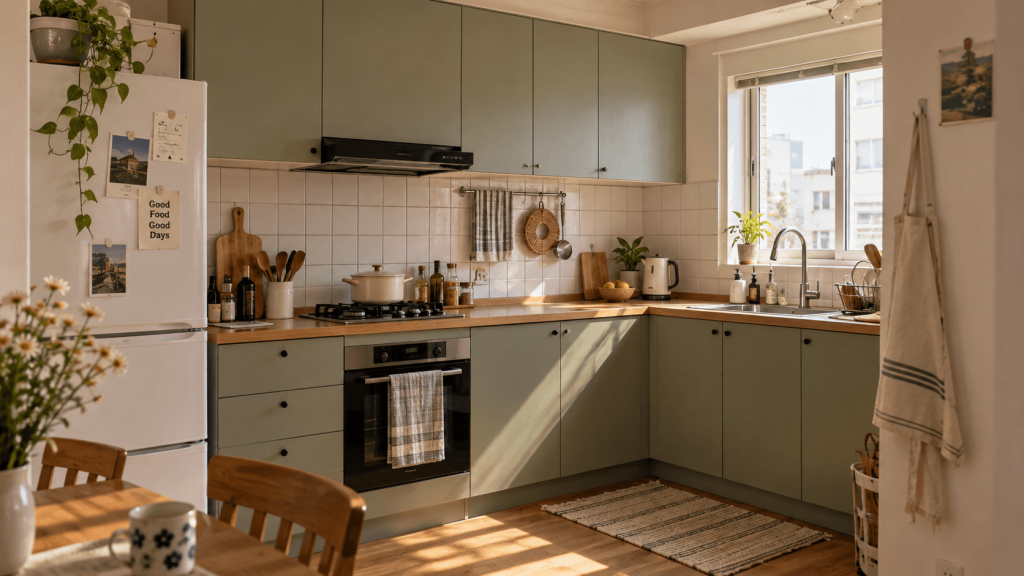
You also expect to stay for another two years.
Decision: Full coverage can make sense.
The cabinet color is a major part of the room, the door shape keeps the project manageable, and you have enough time to benefit from the change.
The first step is not ordering several rolls.
Test one hidden area, then measure the full continuous cabinet run.
16 Shaker Doors + Short Lease + Worn Edges
Now picture a kitchen with sixteen Shaker-style doors and several drawers.
The recessed panels create far more edge work than the flat-door kitchen. A few corners near the sink are already worn, and you expect to move within the year.
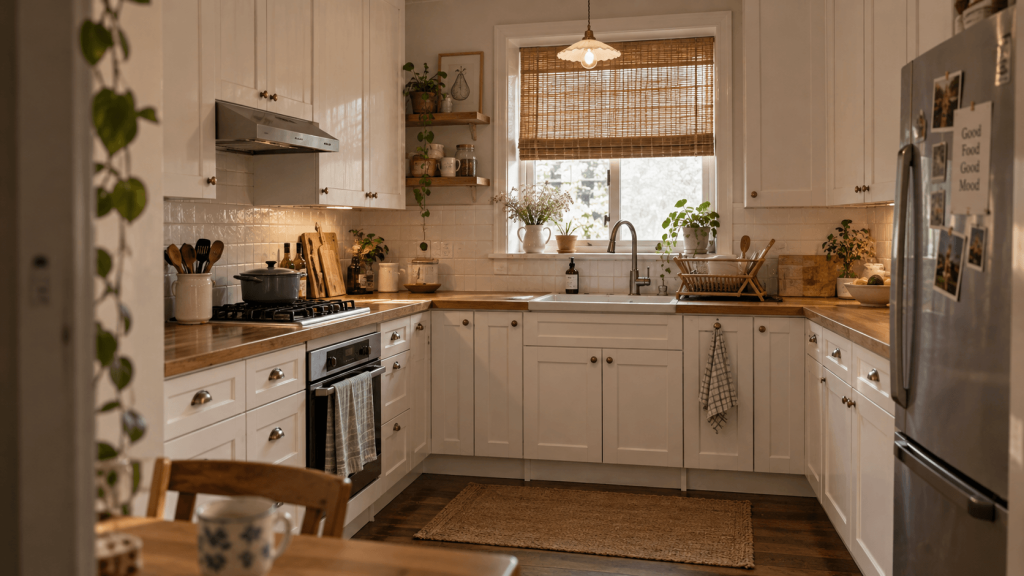
The contact paper may still be inexpensive.
The project is not.
Decision: Skip the full wrap.
Change a lower-effort variable first.
Cabinet hardware is one place to start if the current knobs or pulls are adding to the dated look. Changing cabinet hardware in a rental is much easier to reverse than wrapping sixteen detailed doors, as long as the existing hole spacing works.
Lighting or the contrast around the cabinets may also reduce how strongly the finish reads.
The goal is not to pretend those smaller changes will completely transform the cabinets. It is to avoid giving a short-term rental problem a long-term project.
18 Total Doors, but Only 6 Dark Lowers Face the Living Room
The third kitchen has eighteen cabinet doors in total.
Standing inside the kitchen, it feels like a huge project.
But take a photo from the sofa and the problem changes.
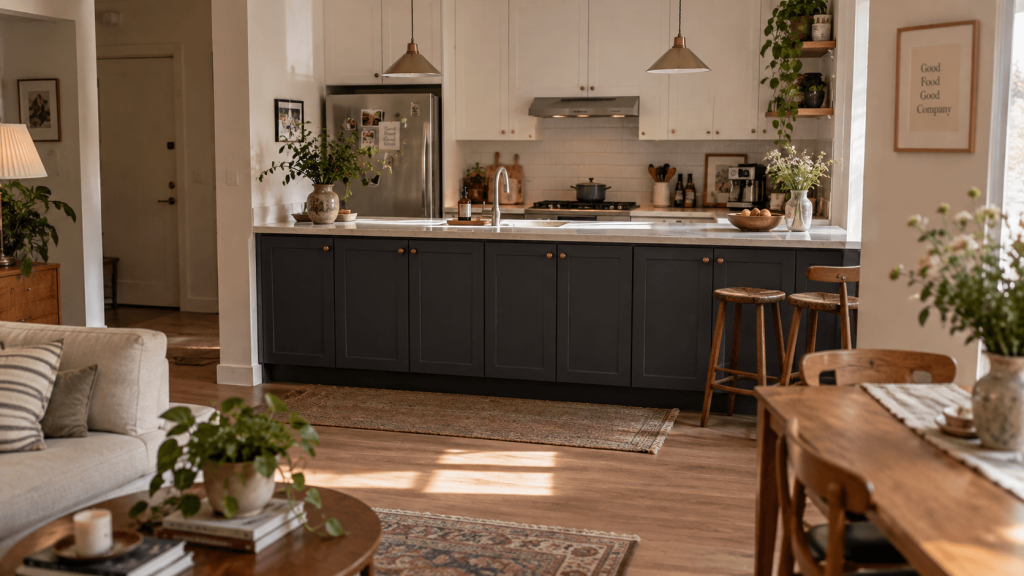
The upper cabinets barely register from that viewpoint. The island is neutral. What keeps pulling your eye is one continuous row of six dark lower cabinet doors facing the living room.
Now imagine only those six doors changing.
If most of the visual weight disappears in the photo, you have found a smaller project.
Decision: Test one continuous partial zone.
Do not measure all eighteen doors.
Test the finish and measure those six lowers first.
If changing that block is enough, the other twelve doors do not need to become part of the project simply because they exist.
So, Is Contact Paper Worth It on Rental Cabinets?
Contact paper is worth it when you are covering the right cabinets—not simply because the material itself is removable.
A stable surface, manageable amount of work, meaningful visual payoff, and enough time left in the rental can make it a reasonable project.
A fragile finish is a reason to stop.
If the project is much larger than the visual problem, cover less—or change something else.
For other temporary rental upgrades, use the Worth It? framework to compare the payoff with the cost, effort, reversibility, and time you have left.
People Also Ask
Can contact paper damage rental cabinets?
It can, especially if the original finish is already weak, peeling, poorly bonded, or damaged. Test a small hidden area first and stop if the existing finish begins lifting or changing.
Can you put contact paper over laminate cabinets?
Some laminate surfaces may work with removable adhesive material, but the condition of the actual surface matters more than the label “laminate.” Check for lifting edges, damaged areas, residue, or other signs that the finish may not be stable, then test a hidden area first.
What should I do if the cabinet finish starts lifting during a test?
Stop. Do not cover the rest of the cabinets.
The test has already given you the information you needed: the existing finish may not tolerate the project well enough to justify expanding it.
Do I need landlord permission to put contact paper on cabinets?
Check your lease and any rules covering alterations before applying adhesive material to landlord-owned cabinets. A product marketed as temporary can still count as a modification if it affects the original finish.
Should I wrap cabinet edges and the inside of the doors too?
Only cover what the finished visible surface actually requires.
Wrapping extra edges or interior areas adds more cutting, adhesive contact, and eventual removal work. Do not expand the project simply for completeness if those areas are not part of the visual problem.