Ugly Rental Countertops? Cover Them, Work Around Them, or Leave Them Alone
Ugly rental countertops? See when to cover them, work around them, or leave them alone—and which renter-friendly fixes are actually worth the effort.

Ugly rental countertops do not always need to be covered. If the surface still works, start by figuring out whether the countertop itself is the problem—or whether clutter, lighting, and the finishes around it are making it feel worse.
A temporary cover can create a big visual change, but it also creates installation and removal work. Before buying contact paper or countertop film, decide how much of that change you actually need.
Quick Take
First, Figure Out What You Actually Hate About the Countertops
“Ugly countertops” can mean several different things.
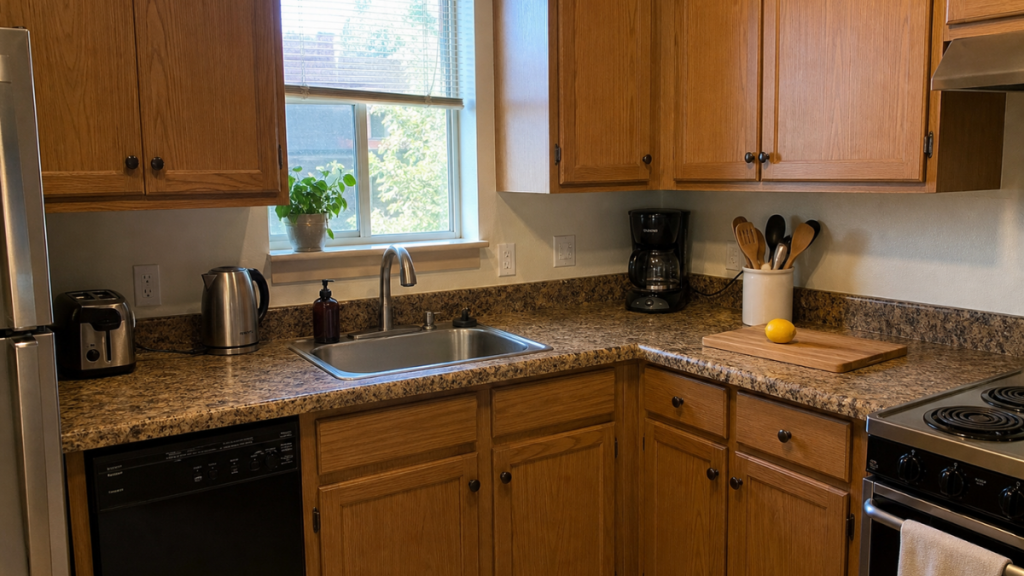
Sometimes it’s the color. Maybe you have orange-brown granite in a kitchen where you’d rather use cooler colors, or yellow-beige laminate that seems to affect everything around it.
Sometimes it’s the pattern. Busy faux stone and heavily patterned granite can dominate a small kitchen even when the surface itself is in perfectly good condition.
The finish can be the problem too. A glossy laminate countertop may feel dated even if its color is relatively neutral.
And then there’s condition.
A countertop that’s chipped, cracked, lifting around the edges, swollen near the sink, or difficult to clean isn’t just an aesthetic problem anymore.
If the countertop is functional and you simply dislike how it looks, you’re making a decorating decision.
If it’s damaged or deteriorating, you may be dealing with a maintenance issue—and that can be a conversation for your landlord rather than a weekend DIY project.
Option 1: Work Around the Countertops
This is where I’d start in most rentals.
Working around an ugly countertop won’t make it disappear. But it gives you a chance to see whether the countertop itself is really the problem—or whether it just feels worse because of the clutter, lighting, and colors around it.
If you’ve already ruled out covering the surface, start with what you can change immediately around the countertop before turning the kitchen into another makeover project.
Cover Some of the Visual Surface
You don’t have to cover every inch of countertop to make it less noticeable.
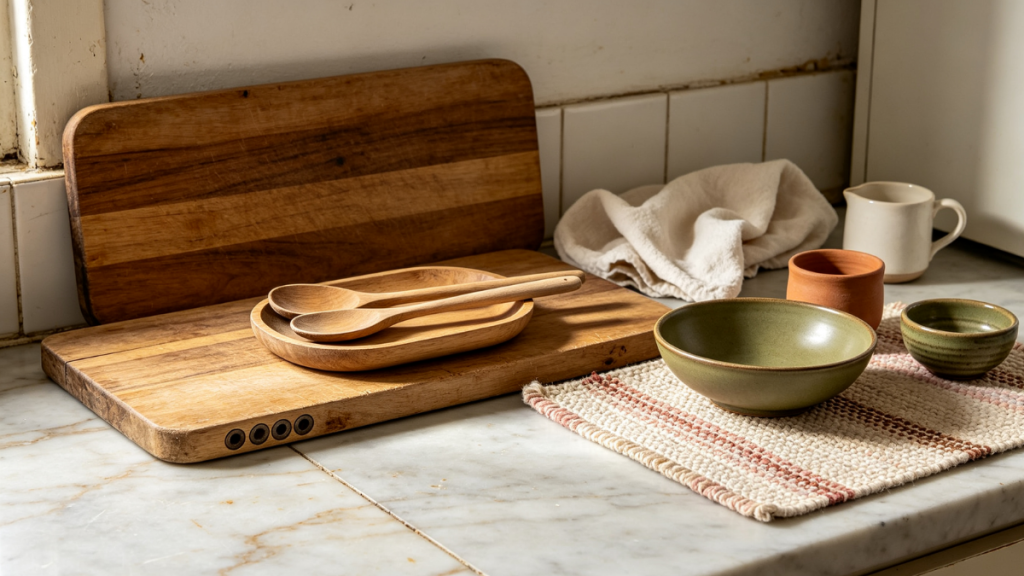
An oversized wooden cutting board can break up a large stretch of busy granite. A tray can turn coffee supplies or cooking oils into one intentional-looking zone instead of several small objects scattered across the surface.
A fruit bowl, bread board, or appliance you actually use can do the same thing.
The key is scale.
Five tiny decorative objects usually create more visual noise. One or two larger, useful pieces interrupt the countertop pattern without making the kitchen feel cluttered.
They also come with you when you move.
Stop Fighting the Countertop Color
Sometimes a countertop feels especially wrong because nothing else in the room relates to it.
Take a typical brown granite countertop.
If everything around it is cool white, silver, and gray, the brown can look like one accidental patch of warmth in the middle of the kitchen.
Instead of trying to erase it, give that color somewhere else to belong.
Wood cutting boards, warm white towels, black accents, terracotta, muted olive, or natural woven materials can pick up tones already present in the countertop.
You don’t need to turn your kitchen brown. A few repeated warm tones may be enough to make the countertop feel less disconnected from everything around it.
Fix the Lighting Before You Judge It
Bad lighting can make a countertop you already dislike look considerably worse.
Cool or harsh overhead light can exaggerate gray tones, yellow tones, shine, and busy patterns. A dark countertop can also make an already dim kitchen feel heavier.
Better lighting won’t change the countertop itself. But it may change how dominant it feels in the room.
If the whole kitchen feels flat or harsh, I’d the lighting problem first before committing to a countertop makeover—especially because renter-friendly lighting can usually move with you.
Option 2: Use a Renter-Friendly Countertop Cover
This is the option that photographs best—and the one I’d think about most carefully before starting.
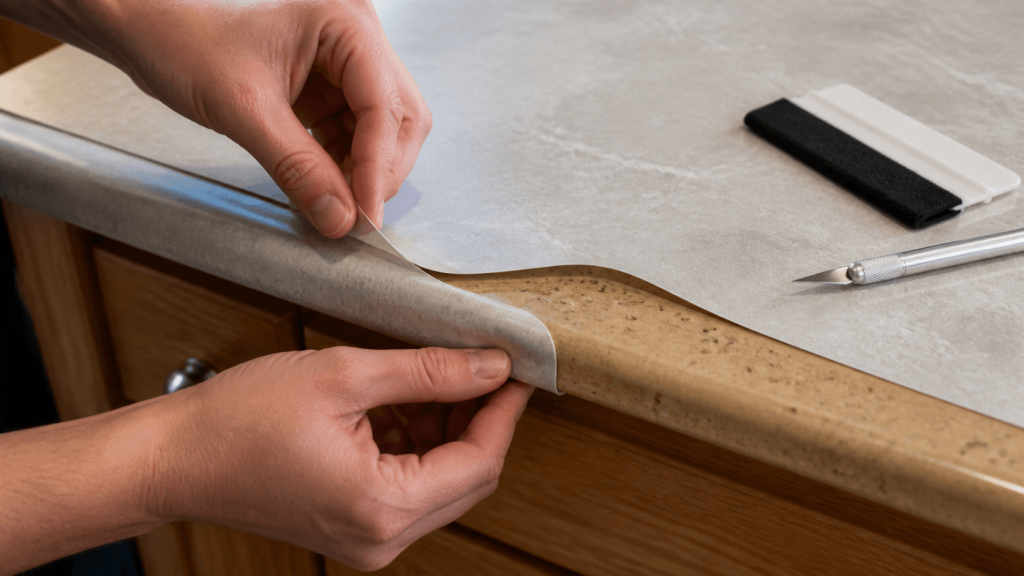
A renter-friendly countertop cover can mean contact paper, peel-and-stick countertop film, removable vinyl, or another temporary surface placed over the existing counter.
These can dramatically change how a countertop looks without permanently replacing it.
The question isn’t simply:
“Can I cover my rental countertops?”
It’s:
“Will I get enough out of this project to make the installation, maintenance, and removal worth it?”
Thinking about covering the surface? Here’s how to decide whether contact paper countertops are actually worth it in a rental.
When Temporary Countertop Covers Make Sense
I’d be more likely to consider temporary coverage if:
- the countertop has a major visual impact on the whole kitchen;
- the existing surface is relatively smooth and straightforward to cover;
- I use the kitchen enough that the change would improve daily life;
- and I expect to stay long enough to actually enjoy the result.
That last point matters.
If you have only four months left on your lease, spending a Saturday wrapping an entire kitchen—and another afternoon removing it later—may be hard to justify.
If you’ve just renewed for another 18 months, cook every day, and the countertop is the one feature that keeps the kitchen from feeling comfortable, the same project starts to make much more sense.
There isn’t a magic number of months. The point is to compare how long you’ll enjoy the change with how much work the full project creates.
And remember that installation is only half of it. You’ll also be living with seams and corners, cleaning the covered surface, and eventually removing the material.
Check your lease and get permission where necessary before applying adhesive materials to a surface you don’t own.
When I’d Skip a Temporary Countertop Cover
I’d be much less enthusiastic if you’re moving soon, the countertop has lots of seams or awkward edges, or you already know that bubbling and imperfect corners will bother you more than the original surface did.
I’d also hesitate if you’re unsure how the adhesive will behave on the existing countertop material or finish.
And cost can creep up.
One inexpensive roll looks like a cheap makeover. Covering an entire kitchen means enough material for the whole surface, extra for mistakes and pattern matching, plus any tools you need.
At that point, it’s worth comparing the full cost—not just the price printed on one roll—with what else that money could improve in the room.
Option 3: Ask the Landlord
Sometimes an ugly countertop is also a countertop that needs attention.
Peeling laminate, swollen areas near water, loose edging, deep cracks, damaged seams, or other deterioration may be more than a decorating problem.
In that situation, document what you’re seeing and raise it with your landlord rather than automatically covering it.
Covering damage can make it harder to keep an eye on what’s happening underneath. And if water damage or deterioration is involved, a cosmetic DIY project may simply hide the problem rather than solve it.
There’s another situation where asking makes sense: you genuinely want a larger change and are willing to discuss it with your landlord.
What’s allowed—and who would pay for it—depends on your lease, landlord, and circumstances. Don’t assume permission, but don’t assume the answer will always be no either.
Option 4: Leave Them Alone
This option gets much less attention because there isn’t much of a makeover to photograph.
But sometimes it’s the smartest rental decision.
Say you have eight months left on your lease.
The countertop works fine. You don’t particularly like it, but covering the whole kitchen would cost money, take most of a Saturday, and create another job when it’s time to move.
How much better would your daily life actually become?
Maybe enough to make the project worthwhile. But if the countertop mostly bothers you when you stop and look at it, rather than when you actually use the kitchen, probably not.
That same money could go toward a floor lamp, dining chairs, storage, a rug, or kitchen equipment you’ll still own after you hand back the keys.
Leaving something alone doesn’t mean deciding it’s beautiful.
It means deciding that this particular problem isn’t worth more of your time, money, or attention.
Here’s how I’d translate that into an actual decision:
High impact + long time left + reasonably reversible → Consider covering it.
If the countertop dominates the kitchen, bothers you regularly, and you’ll be living with it for another year or more, temporary coverage may earn back the effort.
Medium impact + movable solutions available → Work around it first.
If you dislike the countertop but the kitchen is otherwise fine, start with lighting, a large cutting board, a tray, or a few colors that make the existing surface feel more intentional.
Low impact + short time left → Leave it alone.
If you’re moving soon or mostly notice the countertop when thinking about decorating, your money and energy will probably go further somewhere else.
Damage, swelling, cracks, or loose edges → Ask the landlord.
Once the issue moves beyond appearance, stop treating it as a styling decision.
The cheapest-looking DIY isn’t necessarily the lowest-cost option once your time, removal, and move-out work are included.
What I’d Do First
If I moved into a rental tomorrow and hated the countertops, I wouldn’t order countertop film that night.
I’d clear off anything that doesn’t need to live there first. Busy granite plus a crowded countertop can look much worse than either one on its own.
Then I’d look at the lighting. If one harsh overhead fixture is making every color in the kitchen look worse, I’d rather deal with that before committing to a countertop project.
After that, I might add a large wood cutting board or a tray—something useful that breaks up the surface and can come with me when I move.
Then I’d leave it alone for a week.
Not as some formal test. I’d just use the kitchen normally and see whether I still notice the countertop every day, or whether it mostly bothered me because I was focused on fixing the room.
If I still hated it after that, then I’d start looking seriously at temporary coverage.
So, Should You Cover Ugly Rental Countertops?
Ugly rental countertops don’t always need a makeover. If working around them makes the kitchen feel good enough, stop there.
If they still bother you regularly—and you’ll be around long enough to enjoy the result—then temporary coverage becomes a much easier decision to justify.
FAQ
How can I cover ugly countertops in a rental?
Temporary options include removable countertop film or contact paper, but covering the whole surface is not always the best first move. If the countertop still works, first check whether lighting, clutter, or a few large movable items can make it less dominant.
What is the most renter-friendly countertop cover?
The most renter-friendly option depends on the existing surface, how much heat and water the counter sees, and how easily the covering can be removed later. “Removable” does not guarantee that every countertop finish will react the same way, so test the actual surface before covering a large area.
For the adhesive route, see Are Contact Paper Countertops Actually Worth It in a Rental?
Can I cover rental countertops without contact paper?
Yes. Large cutting boards, trays, or other movable surfaces can visually break up part of the counter without attaching anything to it. If you have already ruled out contact paper, see Contact Paper Isn’t Worth It for Your Counter? What to Change Around It Instead.
Should I tell my landlord before covering a countertop?
Check your lease first. Adhesive films may still count as a modification even when they are marketed as removable. If the countertop is already cracked, swollen, loose, or otherwise damaged, document the condition and contact the landlord instead of covering it.