How to Make Old Rental Bathroom Tile Matter Less
Old rental bathroom tile staying put? Learn how to reduce its visual impact through condition, color, scale, and edge relationships without covering it.
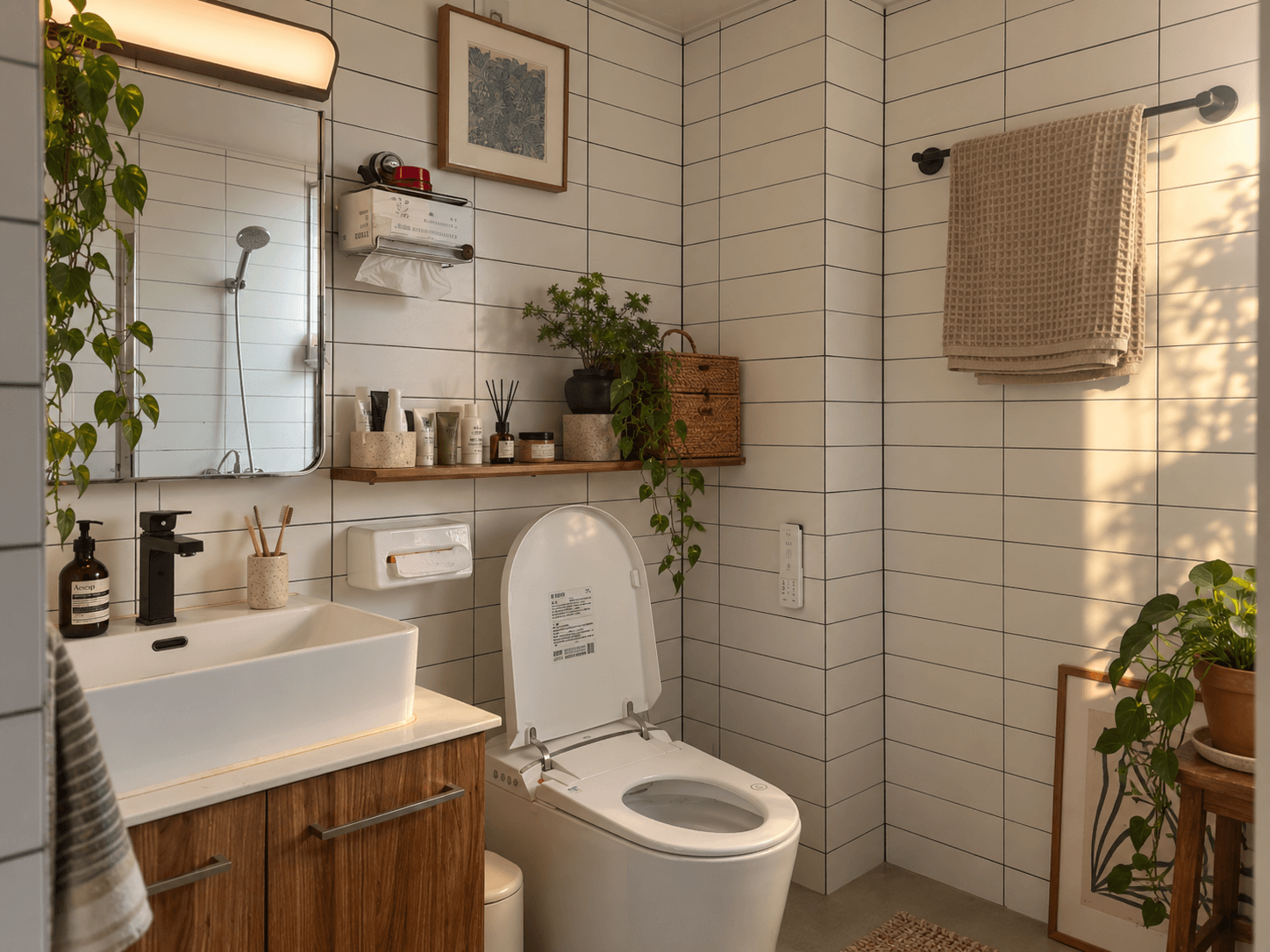
Ugly bathroom tile does not always need to be covered or replaced. If the tile has to stay, start by figuring out what is making it feel so dominant: the color, the grout grid, how much surface it covers, or the finishes around it.
Then change the nearest movable layer instead of trying to modernize every fixed surface.
The goal is not to make the old tile disappear. It is to stop the whole bathroom from organizing itself around it.
If you are still deciding whether the tile is actually the main bathroom problem, start with Ugly Rental Bathroom? What Should You Actually Change? If you are already considering peel-and-stick floor tile, that is a different decision.
Quick Take
First, Figure Out What Makes the Bathroom Tile Feel So Dominant
Before changing the room around the tile, make sure you are reacting to the tile itself.
Old tile can look much worse when soap scum, mineral buildup, dull residue, failing caulk, or dirty grout is sitting on top of it.
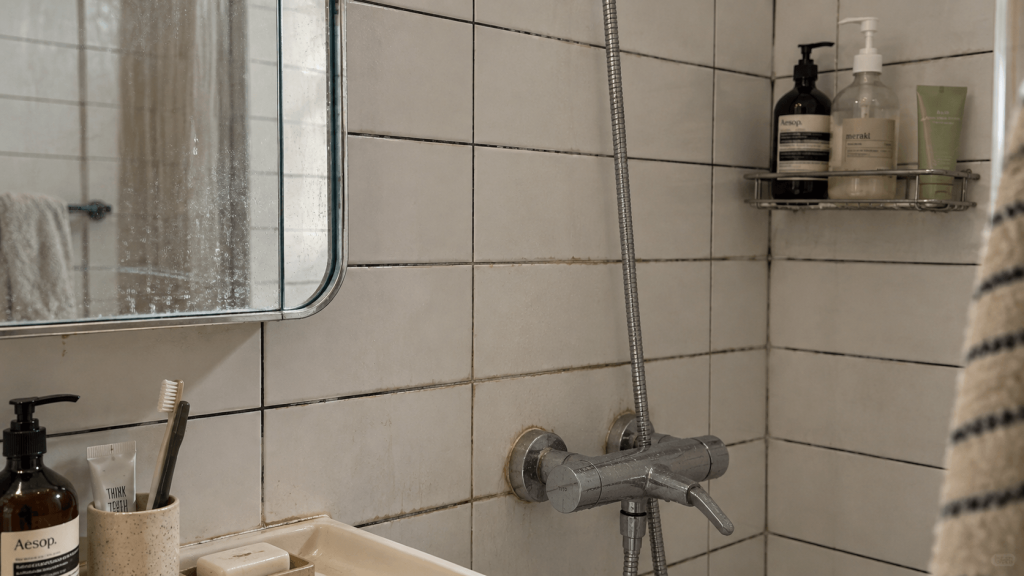
The useful question is:
Am I reacting to the tile design—or to the condition sitting on top of it?
If the tile is intact but looks tired because of buildup or residue, bring it back to a normal baseline before judging how visually difficult it really is.
If tiles are loose, grout is crumbling, caulk has failed, or there are signs of moisture problems, that is not a styling issue.
Do not ask decor to solve maintenance.
Figure Out What Is Actually Making the Tile Loud
Not all old tile is loud for the same reason.
Sometimes the color is doing most of the work. Pink, blue, peach, mustard, or brown tile can pull the eye before you notice much else.
Sometimes the stronger issue is the grout grid, a repeated pattern, or simply the amount of tiled surface.
One simple test can help separate those problems.
Take a normal photo of the bathroom, then look at a black-and-white version.
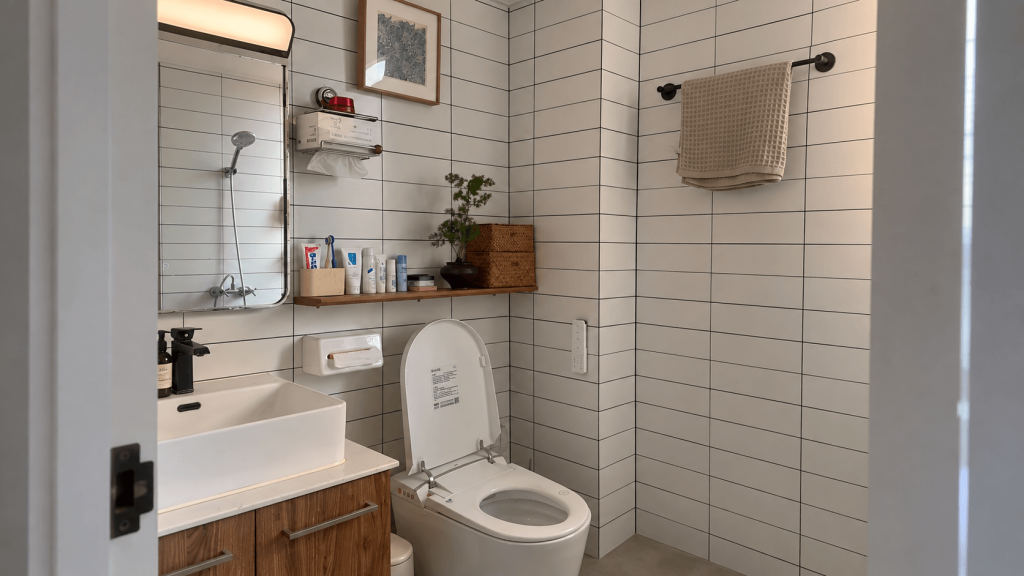
If the tile becomes much less noticeable in grayscale, color is probably carrying most of the visual weight.
If it still dominates, the issue may be coverage, grout contrast, pattern, or scale.
The test does not need to diagnose the room perfectly.
It only needs to stop you from treating every old-tile problem as a color-matching problem.
Know whether you are trying to quiet the color or the tile field itself.
If Color Is the Problem, Echo It Once—Then Stop
When tile has a strong color, the usual advice is to “work with it.”
That can help.
But it is easy to turn one fixed color into the entire bathroom theme.
Blue tile does not require blue towels, a blue bath mat, blue artwork, and a shower curtain with another blue pattern.
One small echo can be enough.
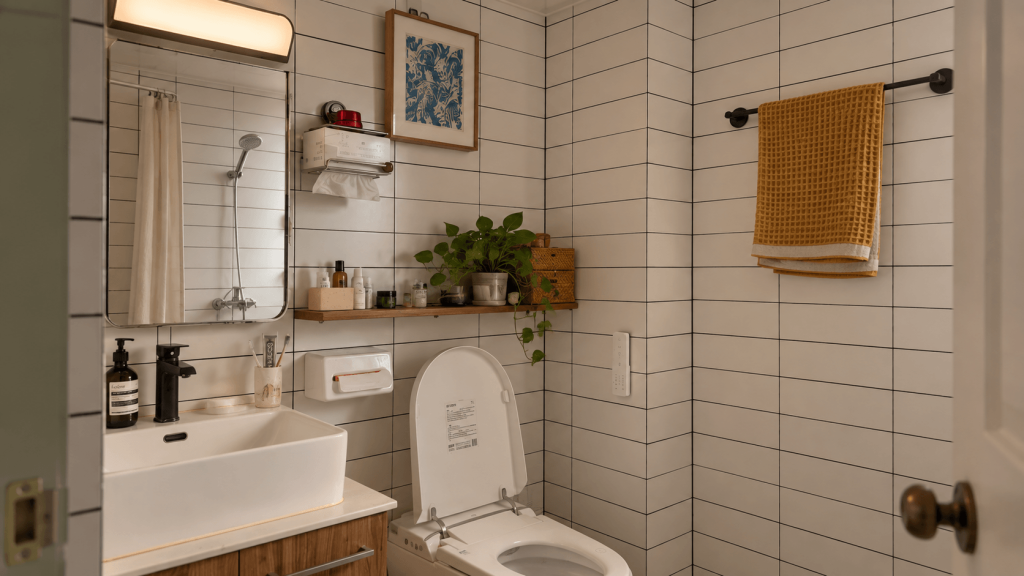
A tone from the tile might appear once in a towel, a small detail in the shower curtain, or a piece of artwork. After that, let your own things relate to each other instead of continuing to report back to the landlord’s tile.
Connection is useful.
Constant repetition is not.
If Coverage Is the Problem, Respond at the Same Scale
Sometimes the problem is not the color.
It is the amount.
Old bathroom tile may run halfway up every wall, wrap the tub, cover the entire floor, or appear on both wall and floor at once.
At that scale, a few small accessories will not change much.
A large repeated surface usually needs one larger visual answer—not ten small accessories.
That larger answer might already be something the bathroom needs anyway: a shower curtain, a substantial textile zone, or another broad surface that gives the eye somewhere else to rest.
The point is not to cover the tile.
It is to stop answering a wall-sized problem with soap-dispenser-sized fixes.
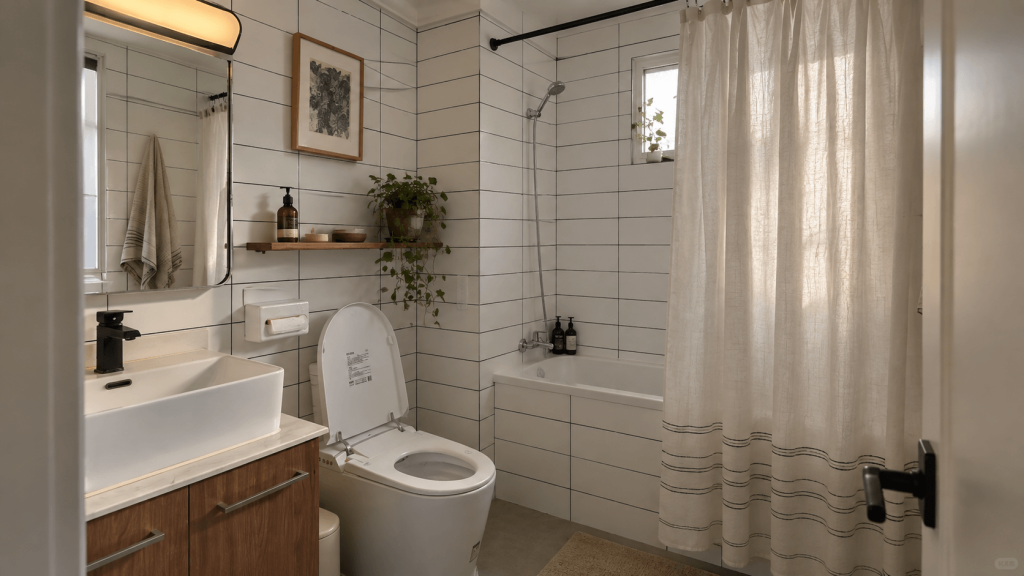
Pay Attention to Where the Tile Stops
Sometimes the tile feels loudest at the edge.
Half-height colored tile may stop abruptly against a bright wall. A tub surround may meet a high-contrast curtain. Floor tile may hit a vanity or threshold that makes the boundary feel especially sharp.
That edge can act like a frame.
Ask:
Is the edge helping the tile recede—or outlining it?
If the boundary is doing most of the work, you may not need to change the tile itself.
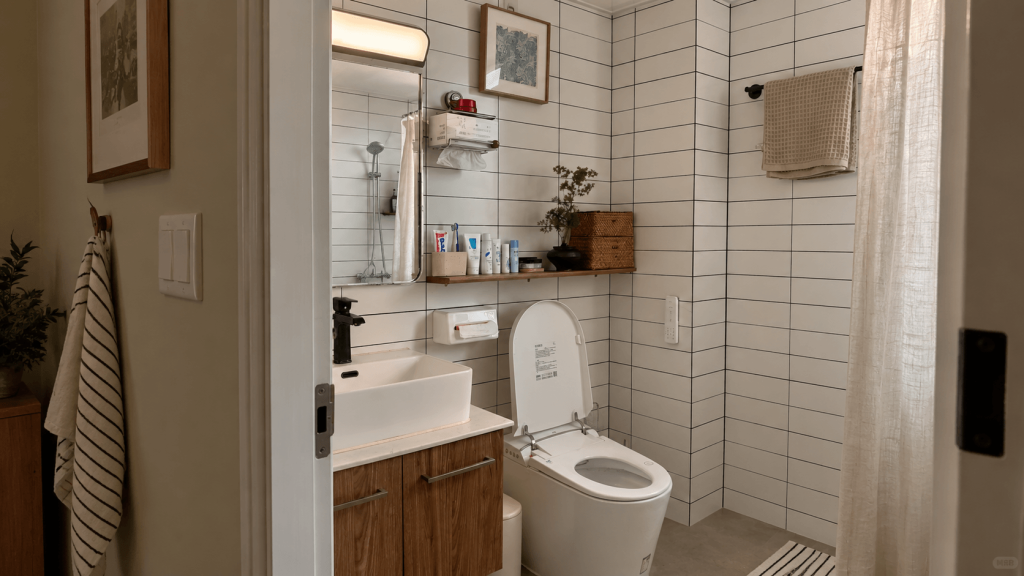
A permitted wall-color change, a different textile, or another adjacent element may soften that transition enough that the tile reads as a surface instead of a statement.
If painting is one of the options you are considering and you would have to restore it later, Is Painting a Rental Worth It If You Have to Paint It Back? is the better place to make that decision.
The important point here is simpler:
Look at what is drawing a line around the tile, not only at the tile itself.
Don’t Turn “Modernizing the Tile” Into Another Project
Old tile can create another trap: trying too hard to make it look current.
Updating bathroom tile without replacing it does not have to mean painting, covering, or resurfacing the tile itself. Sometimes the better move is to change what surrounds it.
You add very modern finishes because the tile feels dated. Then another strong contrast because the bathroom still looks old.
Now the tile is sitting beside several things that make its age even more obvious.
You do not need the tile to look current. You need the room to stop grading it against everything new.
That does not mean you need to embrace a vintage look.
It just means “modernize the tile” should not become the job of every new thing you bring into the bathroom.
Let the tile be the old fixed surface.
Your other choices do not need to correct it.
Know When the Tile Is Simply Part of the Bathroom
At some point, the tile may still be visible and still be old.
That does not mean the workaround failed.
After you deal with condition, color repetition, scale, and strong boundaries, step back again.
Ask:
Does the tile still ruin the bathroom—or is it simply still visible?
Those are different outcomes.
If the bathroom feels calmer, works well, and your own things no longer orbit the tile, you may already be done.
The tile does not need to become invisible.
It does not need to become beautiful.
It only needs to stop being the first thing the room is about.
FAQ
How can I make old bathroom tile look better without replacing it?
Start by figuring out what is actually making the tile feel old or dominant.
Sometimes the issue is buildup or worn grout. Other times it is color, a strong grout grid, the amount of tiled surface, or the contrast where the tile ends. Once you know which part is carrying the problem, you can change the surrounding relationship instead of automatically covering the tile.
What colors work with old bathroom tile?
You do not need to build the whole bathroom around the tile color.
One small echo can create enough connection. After that, let the rest of the room develop its own relationships instead of repeating the tile color everywhere.
How do you make vintage bathroom tile look less dated in a rental?
Focus less on making the tile look modern and more on reducing what emphasizes its age.
Simplify competing finishes, avoid over-repeating the tile color, use one larger visual counterweight when the tile covers a large area, and pay attention to strong contrast where the tile meets another surface.
Should I cover ugly rental bathroom tile with peel-and-stick tile?
Not automatically.
Covering is a separate decision with its own questions about surface compatibility, moisture, permission, installation, and removal. If you are considering peel-and-stick on the floor, Is Peel-and-Stick Floor Tile Worth It in a Rental? goes deeper into that tradeoff.