How to Make Honey-Oak Rental Cabinets Look More Modern Without Painting
Stuck with honey oak cabinets in a rental? Use lighting, contrast, hardware, and nearby surfaces to make them look more modern without painting them.
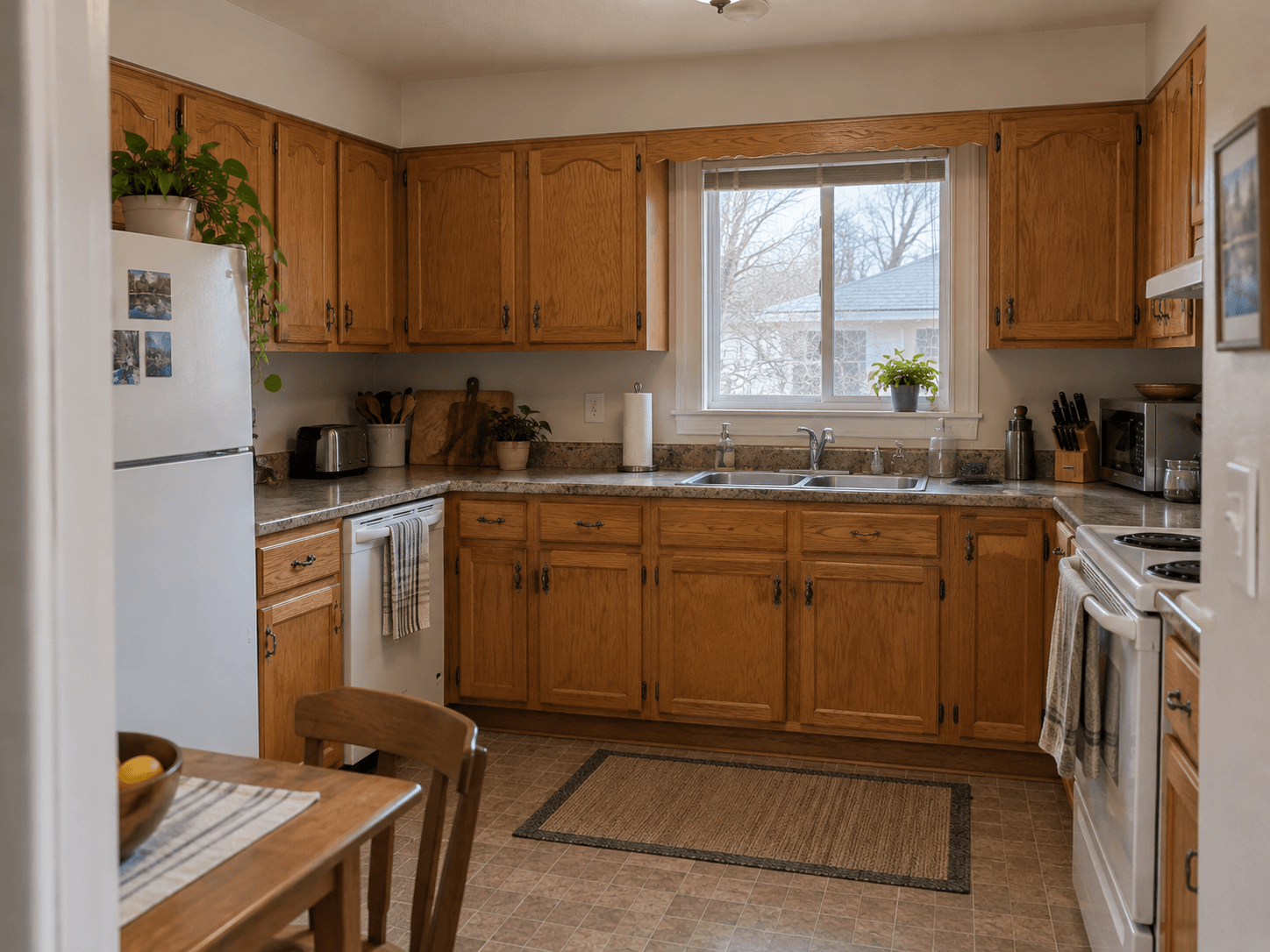
To make honey-oak cabinets look more modern without painting them, start with what surrounds the wood rather than trying to change the wood itself.
Lighting, countertops, hardware, clutter, and nearby colors can all make honey oak feel warmer, heavier, or more dated than it does on its own.
Change one of those variables first. You may find that the cabinets do not need to disappear—they just need to stop doing all the visual work.
Quick Take
Start by Looking at the Oak as Part of the Room
It is easy to stare at one cabinet door and decide the wood is the problem.
But that is not how you actually experience the kitchen.
You see the cabinets next to the countertop, above the flooring, under whatever light the apartment gives you, with appliances and everyday objects sitting nearby. The same warm wood can feel very different depending on what surrounds it.
Stand at the kitchen doorway instead of directly in front of the cabinets.
What else is contributing to the same visual feeling?
Maybe the countertop is brown or heavily speckled. Maybe the floor is beige or tan. Maybe the overhead light gives everything a warmer cast. Maybe the knobs are dark, ornate, or visibly worn. Or maybe cutting boards, wooden utensils, baskets, and countertop clutter are adding more warm tones to an already warm room.
None of that means the cabinets are not part of the problem.
It just helps separate the cabinet problem from the room around the cabinets.
If you are not sure what part of the cabinets is actually bothering you, start with Ugly Rental Kitchen Cabinets? What Should You Actually Change? before trying to solve the finish itself.
If the countertop is actually the surface you notice first, work outward from the counter instead.
Then imagine the kitchen without the current hardware, lighting, countertop clutter, and nearby accessories.
Would the cabinet doors still bother you just as much?
If they would, the finish or door style may genuinely be the fixed feature you dislike.
If not, there is probably more room to work around the cabinets than it first appears.
Remove Some of the Visual Competition Before You Add Anything
The easiest response to a dated kitchen is to start shopping.
A runner. New towels. New hardware. A peel-and-stick backsplash. A few objects that are supposed to make the cabinets look more intentional.
Before adding another layer, try taking a few things away.
Clear part of the countertop for a day. Put away a small appliance you rarely use. Move a few wooden accessories out of sight. If the kitchen mat is busy or adds another warm brown tone, temporarily remove it. Do the same with decor above the cabinets if that area feels crowded.
You do not need to turn the kitchen into an empty minimalist photo.
You are just creating enough visual quiet to see the room properly.
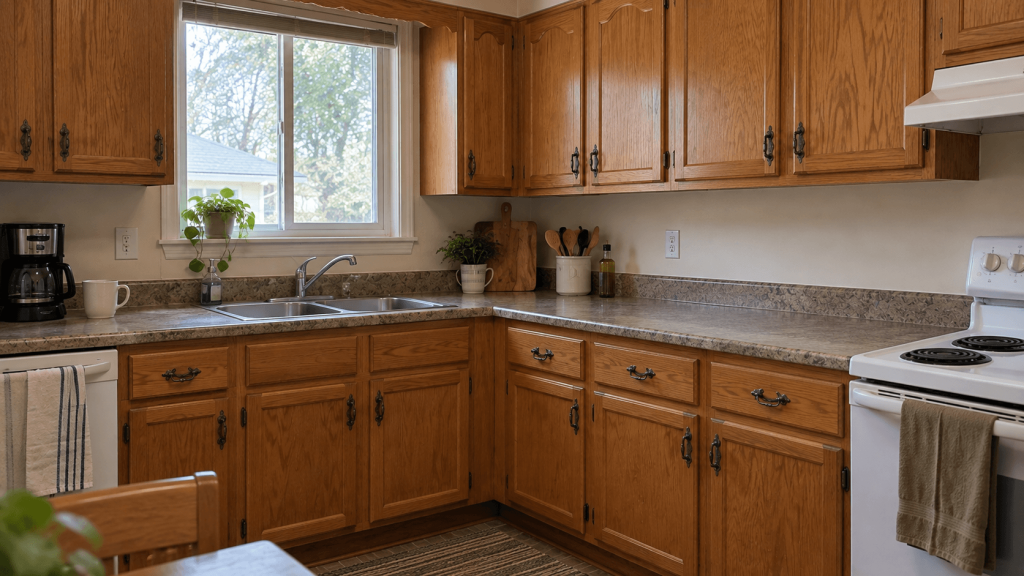
Then leave the kitchen and walk back in.
Do the cabinets still dominate the room in exactly the same way?
Sometimes they will. But sometimes “too much honey oak” is partly too much happening around the honey oak.
That is worth finding out before you buy anything.
Removing visual competition costs nothing, changes nothing permanently, and gives you a cleaner starting point for every decision that follows.
Make Honey-Oak Cabinets Look More Modern by Changing the Context Around Them
Once you can see the kitchen more clearly, start testing the things you actually control.
The useful part is doing it one variable at a time.
Change the lighting, rug, hardware, towels, backsplash, and countertop accessories all at once, and you may end up liking the kitchen more. You just will not know which part made the difference.
That makes it very easy to keep going long after the problem is already mostly solved.
Check the Lighting Before You Correct the Color
Honey oak may not look the same at noon as it does under the kitchen light at night.
Look at the cabinets during the day first. Then look again with the overhead light on. Check them once more in the evening if that is when you use the kitchen most.
Do they bother you equally every time?
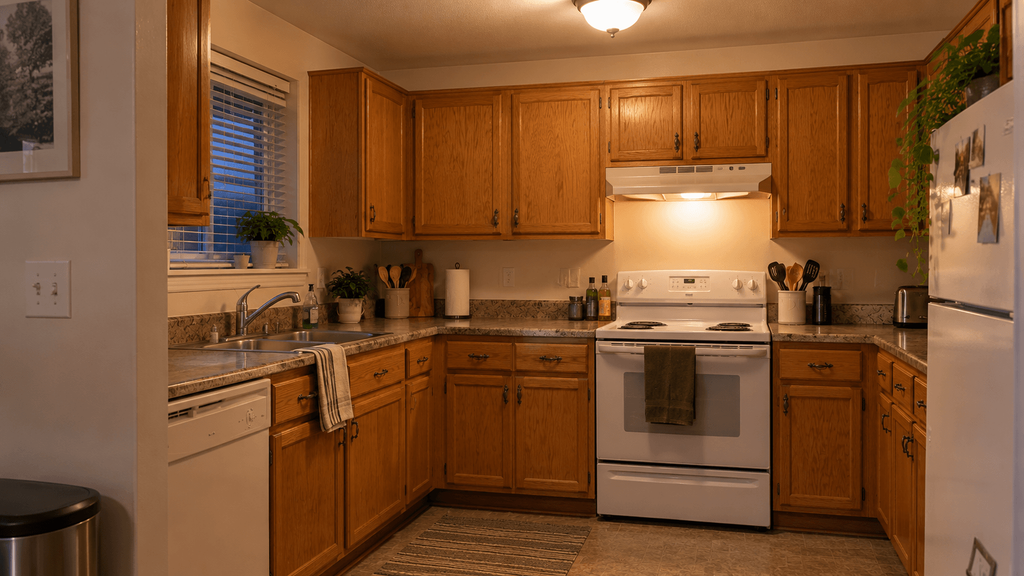
If the wood feels fine in daylight but suddenly looks much more yellow or orange under artificial light, some of what you are reacting to may be the lighting rather than the cabinet finish alone.
That does not mean the answer is automatically a much cooler bulb. Changing the light too far in the other direction can make an ordinary rental kitchen feel harsh even if the cabinets look less warm.
Instead, judge the room as a whole.
Does the lighting make the cabinets, countertop, floor, and the kitchen itself feel better together?
If it does, deal with the lighting before buying decor intended to “correct” the oak.
And if poor lighting is making the entire kitchen harder to live with, How to Fix a Dark Rental Apartment is a better place to start than trying to decorate around the cabinets.
Look at the Counter Zone First
The countertop sits directly against the cabinets, so it has an outsized effect on how all that wood reads.
Honey oak beside a relatively simple surface can feel very different from the same cabinets beside a busy brown-speckled counter.
Add a tan floor underneath, and the lower half of the kitchen can start reading as one continuous warm surface.
That still does not mean the counter needs to be covered.
Start with what is sitting on it.
Clear one section. Put away a few visible appliances. Break up a cluster of small objects. If you already own something lighter or darker that naturally belongs in the kitchen—a tray, bowl, utensil crock, or towel—try it there.
Then step back.
You are not trying to style the countertop for a photograph. You are checking whether the cabinets and counter still blur together into the same visually heavy area.
If the countertop itself turns out to be what is bothering you, treat that as a separate decision. Ugly Rental Countertops? What Should You Actually Change? goes deeper into that problem.
Use Movable Contrast to Modernize Honey Oak
Once the room is simpler, a little contrast can help separate the cabinets from everything around them.
You do not need to find the one perfect “color for honey oak.”
Your countertop, floor, wall color, lighting, and amount of wood all affect what will feel right in the room.
Instead, look for one direction that gives the oak some separation.
That might be a soft cream or off-white. A muted green may work in another kitchen. A darker charcoal or black accent can create more definition. Sometimes even one restrained cooler-toned element is enough to break up a room where nearly every surface feels warm.
What matters more is where you use it.
A runner can interrupt a large stretch of warm flooring. A towel can quietly repeat a color used elsewhere. One darker object on the counter may create more useful contrast than five small pieces of decor.
Pick one supporting direction and repeat it a couple of times.
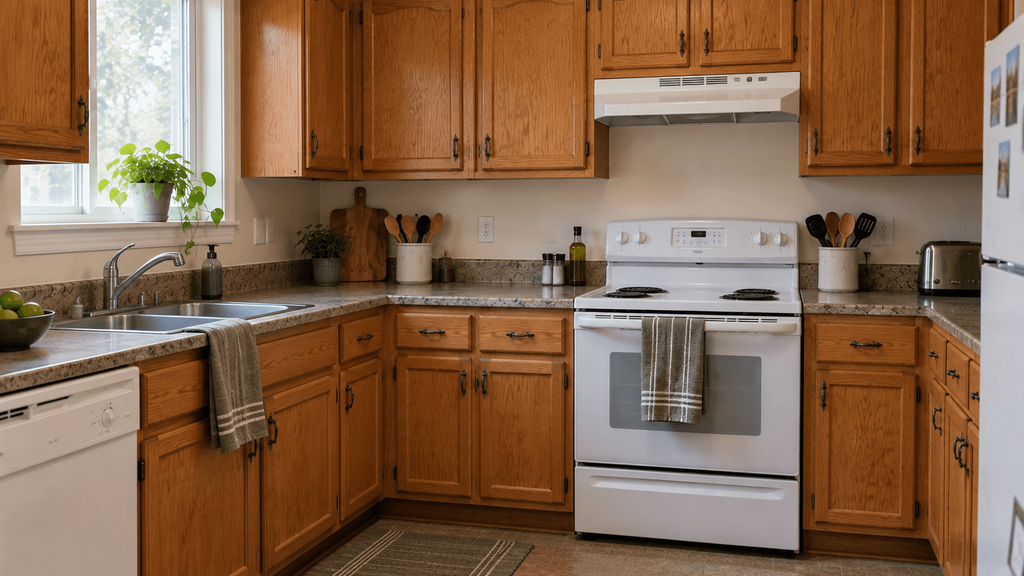
You do not need a theme.
The goal is to interrupt the wall of warm wood, not decorate around it until the room becomes busier.
Test the Hardware Only If the Hardware Is Part of the Problem
Honey oak sometimes gets blamed for a dated look that the hardware is helping create.
A relatively simple cabinet door paired with ornate pulls, worn knobs, or visually heavy hardware can read very differently once that detail is removed.
But that does not mean every honey-oak kitchen needs new handles.
Take one piece off and look at the cabinet without it.
If the door suddenly feels simpler, hardware may be carrying more of the dated look than you expected.
Then, if you want to test a replacement, try one before committing to the whole kitchen.
And do not judge it from two inches away. Step back until you can see the cabinet as part of the room.
Does it actually feel different?
Or is it still the same cabinet you disliked, now with a nicer handle?
If the test looks promising, Should You Change Cabinet Hardware in a Rental? When It’s Worth It—and When It Isn’t covers the rest of that decision before you buy replacements for every door and drawer.
Don’t Build a Temporary Makeover Around One Permanent Finish
There is a point where working around a rental feature turns into building an entire temporary renovation around it.
Honey-oak cabinets can be very good at pulling you into that cycle.
First comes the hardware.
The kitchen still feels dated, so you start looking at a peel-and-stick backsplash.
Then the countertop feels wrong next to the backsplash, so now contact paper is on the list.
Then the floor needs a runner.
Then the wall needs something.
Then a few more accessories are supposed to pull everything together.
Any one of those changes might genuinely improve the room. The problem is when each new project exists mainly because the previous one failed to make the cabinets disappear.
The cabinets are still there.
Now you also have several temporary materials to buy, install, live with, and eventually remove.
That is a lot of work to spend arguing with one finish you cannot change.
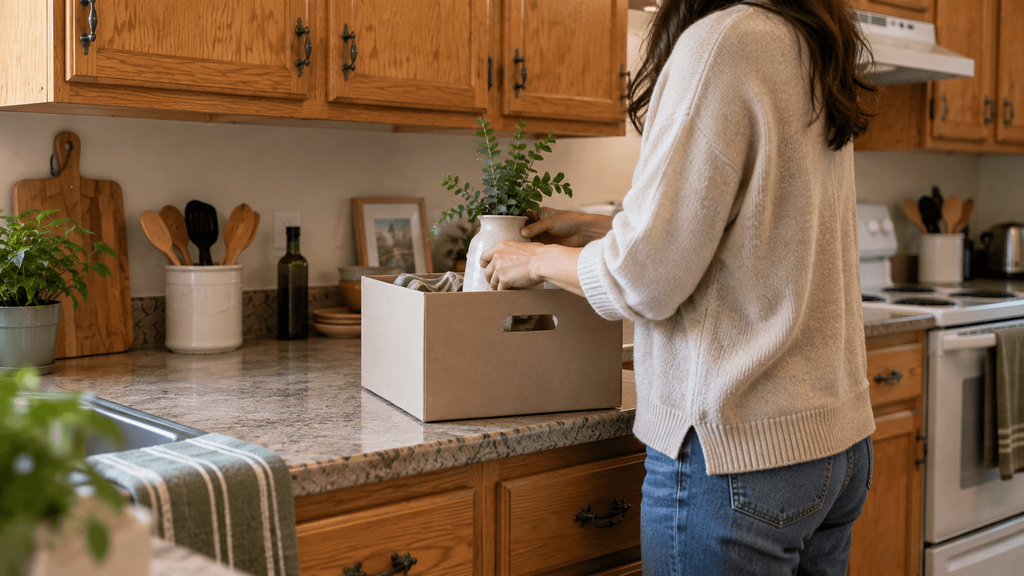
Give yourself a stop rule:
You do not need to keep improving it just because there are still things you would change if the apartment were yours.
And if you simplify the room, improve the lighting, add some contrast, and test the hardware—and the cabinet doors are still the first thing you dislike every time you walk in—the answer may simply be that you dislike the cabinets.
That is not another invitation to find a hack.
This may be a fixed feature you work around rather than solve.
So, What Should You Change First?
If the whole kitchen feels orange, brown, or visually heavy, remove some visual competition first.
If the cabinets look much worse under artificial light, test the lighting first.
If the counter seems to merge into the cabinets, simplify the counter zone first.
If the hardware is what immediately reads dated, test one replacement before buying the full set.
If the room mainly needs some separation from all that warm wood, add one controlled source of contrast and repeat it sparingly.
And if the cabinet doors themselves are still what you dislike after everything else has been stripped away, stop asking rugs, towels, hardware, and removable surfaces to solve a fixed cabinet.
Honey oak does not have to become your favorite finish.
The goal is simply to make it stop deciding how the entire kitchen feels.
FAQ
How do you make honey-oak cabinets look modern without painting them?
Start with the lighting, hardware, countertop zone, and colors around the cabinets rather than trying to alter the wood itself. If one or two surrounding changes reduce how warm or visually dominant the oak feels, stop there. In a rental, the goal is not to turn honey oak into a completely different cabinet—it is to make the whole kitchen read more intentionally.
What colors work with honey-oak cabinets in a rental?
Light neutrals, muted greens, darker accents, and some cooler-toned elements can all work with honey oak, but there is no single best color. Look at the countertop, flooring, wall color, and lighting already in the kitchen, then choose one direction that gives the wood some separation without introducing several competing colors.
Should you use black hardware with honey-oak cabinets?
Black hardware can create useful contrast in some honey-oak kitchens, but it is not automatically an improvement. Try one piece first and judge the whole cabinet from a distance. If you are considering changing every knob or pull, Should You Change Cabinet Hardware in a Rental? When It’s Worth It—and When It Isn’t covers what to check before committing to the full set.
How can you update honey-oak rental cabinets without contact paper?
Start by simplifying what surrounds the cabinets, checking whether the lighting is exaggerating their warmth, reducing visual clutter around the countertop, and adding contrast through movable textiles or accessories. If the hardware is contributing to the dated look, test one replacement. The goal is not to disguise every cabinet surface—it is to make the fixed finish less dominant without creating another temporary renovation project.